International food standards bodies provide detailed guidelines for sugar quality assessment that apply directly to coconut sugar crystallization issues. ICUMSA’s international sugar analysis standards define specific methods for measuring crystal size distribution, color grading, and moisture content—all critical parameters that determine whether a batch remains free-flowing or forms clumps during storage and transport.
Chemical analysis reveals that coconut sugar’s complex composition significantly influences its crystallization behavior compared to refined cane sugar. Research published in PubMed’s coconut sugar chemical analysis studies demonstrates that coconut sugar contains 3-4% minerals and trace elements—substantially higher than the 0.1-0.5% found in white sugar—which directly impacts crystal formation kinetics and the tendency for inter-particle bonding under humid conditions.
Food authenticity testing has become increasingly important as coconut sugar enters premium export markets where quality consistency commands better pricing. A comprehensive study in Food Control Journal on coconut sugar adulteration detection identifies specific compositional markers and physical characteristics that distinguish genuine coconut sugar from adulterated products, including crystal morphology patterns that correlate with proper processing techniques and crystallization control.
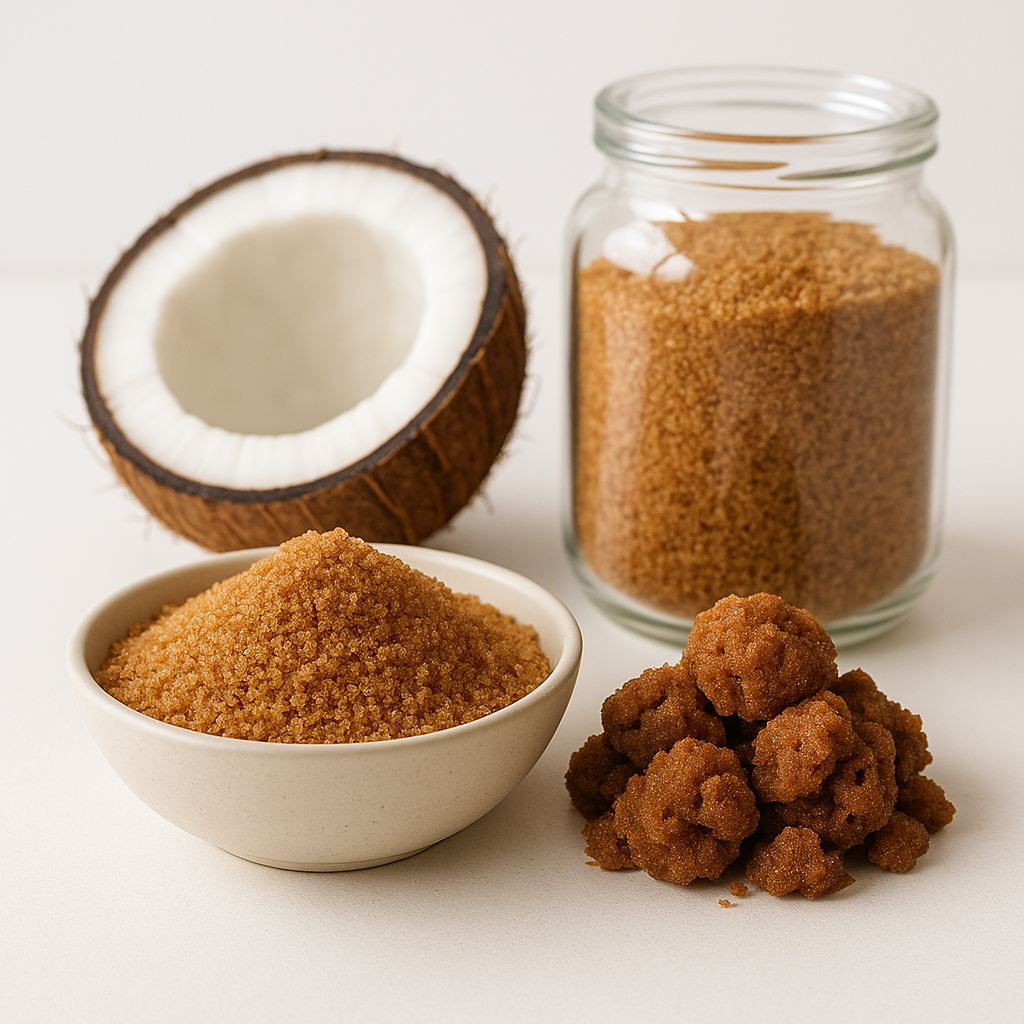
Sugar crystallization is one of the trickier parts of coconut sugar production. Understanding Crystallization Control in Coconut Sugar helps explain why some batches come out perfectly granular while others end up clumped together. The difference usually comes down to a handful of factors—chemistry, heat, moisture, and handling—that interact in ways worth understanding if consistent texture is the goal.
Chemical Composition and Molecular Dynamics
The fundamental chemistry of coconut sugar—the interplay between its various sugars and minerals—dictates a lot of its physical behavior during processing and storage. Each component plays a part in the final texture.
Sucrose, Glucose, and Fructose Ratios
The ratio of sucrose, glucose, and fructose has a big influence on how readily the sugar crystallizes. Higher fructose levels, for instance, tend to inhibit sucrose crystallization—which explains some of the textural variation between batches. Sucrose inversion during cooking can shift these ratios significantly, affecting Crystallization Control in Coconut Sugar outcomes.
Impact of Mineral Content on Crystal Lattice Formation
Trace minerals in coconut sugar play a surprisingly large role in crystallization. These compounds can act as nucleation sites or interfere with crystal growth, leading to noticeably different crystal structures from batch to batch.
Potassium, magnesium, and calcium are naturally abundant in coconut sugar, and these ions can integrate into the developing sucrose crystal lattice or adsorb onto crystal surfaces. The result can be distorted crystal shapes, inhibited growth, or smaller, less organized crystals. Understanding the ash chemistry and mineral speciation factors directly into the final texture and stability of the product.
Thermal Processing and Evaporation Control
The way raw coconut sap is heated to remove water has a direct effect on crystallization. Rapid heating can push the syrup into supersaturation too quickly, leading to uncontrolled crystallization and larger, harder granules. Consistent, gentle heat gives much better control over how crystals form.
Critical Temperature Thresholds for Grain Development
Temperature control during evaporation directly influences the size and number of sugar grains that form. Identifying the point where the sugar concentration reaches saturation—and holding specific temperature ranges around it—helps steer the final texture. The choice between traditional wok and vacuum evaporation methods plays a major role in achieving consistent Crystallization Control in Coconut Sugar.
Temperature Control for Coconut Sugar Crystallization
| Process Stage | Recommended Action |
|---|---|
| Initial Heating | Slow, steady increase to prevent localized scorching. |
| Evaporation | Maintain consistent temperature to avoid rapid supersaturation. |
| Cooling | Gradual reduction to promote uniform crystal growth. |
The Role of Mechanical Agitation in Nucleation
Agitation during the cooling phase is one of the most effective tools for shaping crystal size. Continuously stirring the syrup prevents large, irregular crystals from forming and instead encourages the formation of many small crystal nuclei.
Gentle stirring introduces shear forces that break up nascent crystals and distribute them evenly through the solution. This process, known as secondary nucleation, is what produces a fine, consistent grain structure. Without it, a batch tends toward a few large, undesirable crystals instead of the smooth, homogenous texture that marks high-quality coconut sugar. Proper granulation and mesh size control during this stage is essential.
Moisture Content and Hygroscopic Stability
Moisture content is another major factor in Crystallization Control in Coconut Sugar. The journey from sap to finished product determines the sugar’s initial moisture level, and too much of it tends to encourage clumping rather than a clean granular texture.
Water Activity (aw) and the Transition to Clumping
Water activity (aw) measures the unbound water available for reactions. When it’s high, sugar molecules move more freely and collide more often, and that extra crystal growth tends to show up as clumping rather than a clean grain. Maintaining proper water activity is critical for keeping coconut sugar free-flowing.
Equilibrium Relative Humidity in Storage Environments
Equilibrium Relative Humidity (ERH) describes the moisture balance between the sugar and the surrounding air. If the sugar’s ERH is lower than the relative humidity of the storage environment, it will absorb moisture from the air—and that’s a direct path to clumping.
This back-and-forth exchange of moisture directly affects stability. In overly humid storage, the sugar absorbs water vapor, its water activity rises, and sugar bridges start forming between individual crystals—bridges that solidify into the clumps everyone wants to avoid. Too dry, on the other hand, and the sugar can lose moisture and turn into a harder, less free-flowing product. Getting the storage ERH right is what keeps the sugar in its intended granular state. The phenomenon is closely related to glass transition behavior in humid climates.
Post-Production Cooling and Sifting
Once a batch is cooked, post-production handling has a major say in the final texture. The way a batch is cooled and sifted often determines whether it stays granular or clumps.
Controlled Cooling Rates to Prevent Agglomeration
Managing the cooling rate after cooking matters more than it might seem. Rapid cooling tends to form small crystals quickly, which produces a fine powder that easily agglomerates. Slower, controlled cooling allows larger, more distinct crystals to form and helps prevent clumping. The timing starts much earlier, though—sap collection timing influences composition from the start.
Mechanical Grading for Uniform Particle Size Distribution
Mechanical sifting separates particles by size, removing oversized clumps and overly fine powder to leave a more uniform product. Consistent particle size is one of the simpler ways to keep further clumping in check.
The grading process itself involves passing the cooled sugar through a series of screens with different mesh sizes, which segregates the crystals and isolates those that meet the target granularity. Eliminating both the large agglomerates and the very fine dust produces a more homogenous product—and this sorting step does a lot of the heavy lifting in keeping the final product free-flowing and stable.
Packaging and Environmental Barrier Solutions
Packaging choices have a long reach when it comes to stability. Materials that limit moisture ingress and buffer environmental fluctuations go a long way toward keeping the intended texture intact and preventing clumping down the line.
Vapor Transmission Rates in Packaging Materials
The vapor transmission rate (VTR) of the packaging is worth paying attention to. A high VTR lets moisture in easily and speeds up clumping, so low-VTR materials are the better bet for protecting the product from ambient humidity.
Stabilization Techniques for Long-Term Granularity
Manufacturers often add stabilization measures within the packaging itself to extend shelf life—desiccant packets or oxygen absorbers, for instance, actively manage moisture and reduce the risk of caking. These interventions also help preserve flavor stability over shelf life.
Advanced barrier coatings on packaging films are another option—they add a further layer of protection against moisture permeability and extend the time the sugar stays free-flowing. None of these measures work in isolation; it’s the combination of chemistry, processing, cooling, and packaging that ultimately decides whether a batch stays granular or ends up in a clump.
Key Takeaways
Crystallization Control in Coconut Sugar hinges on managing several interconnected variables. The mineral content influences how crystals nucleate and grow, while the balance of sucrose, glucose, and fructose determines the ease of crystallization. Thermal processing parameters—temperature consistency and controlled agitation—shape grain size and uniformity. Moisture control through proper drying, monitoring water activity, and matching storage ERH keeps the product granular instead of clumped. Finally, mechanical grading and barrier packaging preserve that texture through distribution and storage. Master these elements together, and the result is a consistent, free-flowing product batch after batch.