Table of Contents
Just when you thought you understood sugar, you discover the complex science behind coconut sugar’s caking. You see, the Glass Transition of Coconut Sugar is a critical factor in its behavior. You can unlock the secrets of the Glass Transition of Coconut Sugar and engineer solutions. Understanding the Glass Transition of Coconut Sugar allows you to prevent caking. This post empowers you to master the Glass Transition of Coconut Sugar.
Understanding the chemical composition of coconut sugar is fundamental to explaining its hygroscopic behavior. According to a comprehensive nutritional profile review published in PMC, coconut sugar contains approximately 70-79% sucrose, with the remainder consisting of reducing sugars (3-9% fructose and glucose), moisture (1.5-3%), minerals including potassium, magnesium, zinc, and iron (up to 2%), and trace amounts of inulin and polyphenols. This compositional variability, particularly the ratio of crystalline sucrose to amorphous reducing sugars, directly influences the material’s glass transition temperature and susceptibility to moisture-induced phase changes.
The global coconut sugar market dynamics underscore the commercial importance of solving caking challenges for B2B buyers. Grand View Research’s coconut sugar industry analysis projects the market to reach USD 2.1 billion by 2030, growing at a CAGR of 5.2% from 2023 to 2030, driven primarily by demand from health-conscious consumers in North America and Europe seeking alternative sweeteners with perceived lower glycemic impact. For exporters, maintaining free-flowing product characteristics throughout international shipping and warehousing directly impacts customer satisfaction and repeat purchase rates in this expanding market.
Quality standardization for coconut sugar exports requires adherence to international analytical methods that can objectively measure moisture content, color, and purity parameters. The International Commission for Uniform Methods of Sugar Analysis (ICUMSA) provides standardized testing protocols for sugar quality assessment, including color measurement (ICUMSA units), moisture determination, and ash content analysis that are recognized by importers worldwide. These standardized methods enable consistent specification communication between Indonesian producers and international buyers, particularly for determining critical moisture thresholds below which glass transition-related caking can be avoided during storage and transport.
The Molecular Architecture of Coconut Sugar: Amorphous vs. Crystalline States
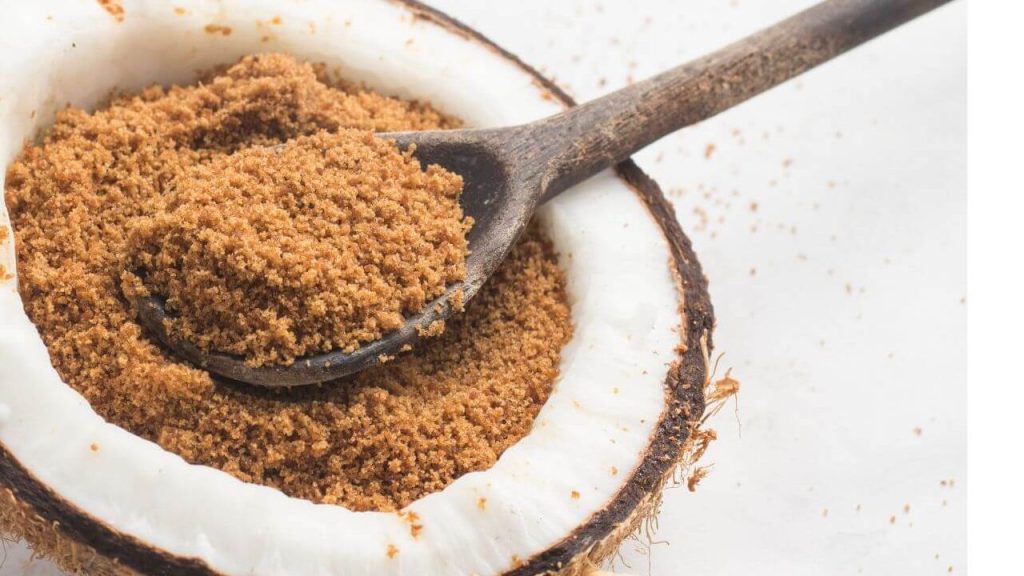
You understand now that the Glass Transition of Coconut Sugar dictates its behavior. Coconut sugar exists predominantly in an amorphous, glassy state, rather than a crystalline one. This non-uniform arrangement of molecules, lacking long-range order, is key to its unique properties and susceptibility to caking.
Compositional Analysis: Sucrose, Fructose, and Glucose Ratios
Your coconut sugar’s specific blend of sucrose, fructose, and glucose profoundly influences its glass transition. These monosaccharides and disaccharides create a complex mixture, preventing easy crystallization. The varying ratios affect molecular packing and overall stability.
The Formation of Meta-stable Amorphous Glasses during Evaporation
During processing, the rapid evaporation of water from the coconut sap forms these meta-stable amorphous glasses. The swift removal of solvent locks sugar molecules into a disordered, non-crystalline arrangement.
The speed of water removal during production directly impacts the resulting sugar’s structure. If evaporation is too slow, crystallization can occur, yielding a different texture. Rapid drying, however, prevents the sugar molecules from aligning into an ordered lattice, instead freezing them into a disordered, glassy state.
Molecular Mobility and the Free Volume Theory in Sugar Solids
Understanding molecular mobility is crucial for comprehending the *Glass Transition of Coconut Sugar*. Free volume theory explains how the empty space between molecules allows for movement. As temperature increases, this free volume expands, increasing molecular mobility.
The concept of free volume, the unoccupied space between molecules, is critical to understanding how sugars transition from a rigid glass to a rubbery liquid. Below the glass transition temperature, free volume is minimal, restricting molecular motion. As you increase the temperature, the molecules gain enough kinetic energy to overcome intermolecular forces, expanding the free volume. This expansion allows for greater molecular rearrangement, leading to increased flexibility and, eventually, flow. This change directly impacts the physical properties you observe in coconut sugar.
Hygroscopic Sugar Matrices and Moisture-Driven Plasticization: Coconut Sugar’s Caking Enigma
Coconut sugar is predominantly amorphous sucrose with traces of fructose and glucose, making it highly hygroscopic and prone to absorbing atmospheric moisture. When water molecules penetrate the sugar matrix, they disrupt intermolecular forces, lowering the Glass Transition of Coconut Sugar and initiating plasticization, leading to the undesirable caking in humid climates.
The Role of Hydroxyl Groups in Water Molecule Adsorption
Water molecules readily form hydrogen bonds with the numerous hydroxyl groups present on sugar molecules. This strong affinity pulls moisture from the air, increasing the sugar’s water content and directly impacting the Glass Transition of Coconut Sugar.
Plasticization Mechanics: Increasing Inter-molecular Distance
Water acts as a plasticizer by inserting itself between sugar molecules. This increases the free volume within the amorphous matrix, allowing individual sugar molecules greater mobility and flexibility.
You observe this effect as the sugar transforms from a brittle, glassy state to a softer, rubbery consistency. The increased molecular movement significantly reduces the energy required for molecules to rearrange, directly lowering the Glass Transition of Coconut Sugar and making it more susceptible to caking.
Quantitative Impact of Moisture Content on Glass Transition Depression
Even small increases in moisture content can drastically depress the Glass Transition of Coconut Sugar. A mere 1-2% increase in water can shift the glass transition temperature by several degrees Celsius.
This quantitative relationship highlights the sensitivity of coconut sugar to environmental humidity. You must control moisture levels precisely to prevent the unwanted caking. Understanding this impact is key to engineering around the caking problem and preserving the desirable texture of your product.
The Critical Temperature Threshold Where Flow Begins
| Concept | Explanation |
| Glass Transition Temperature (Tg) | This is the temperature where an amorphous solid transforms from a rigid, glass-like material to a more pliable, rubbery state. |
| Molecular Mobility | Above Tg, molecules gain enough energy to move more freely, leading to changes in material properties. |
Defining the Glassy-to-Rubbery Transition in Disordered Solids
You can observe this shift when the coconut sugar’s amorphous structure gains enough thermal energy. Its molecules begin to move, transitioning from a rigid glass to a more flexible, rubber-like material. This is the core of the Glass Transition of Coconut Sugar.
Surface Tackiness and the Initiation of Viscous Flow
A slight increase in temperature above Tg makes the surface of your coconut sugar sticky. This tackiness is the initial sign of viscous flow, where individual particles begin to adhere to each other. This directly impacts the Glass Transition of Coconut Sugar.
The surface of individual coconut sugar particles develops a sticky, tacky layer as they absorb moisture or experience elevated temperatures. This layer, a direct consequence of the Glass Transition of Coconut Sugar, acts as a molecular glue. It allows particles to lightly adhere, initiating the agglomeration process. You will notice this tackiness long before any significant clumping occurs.
Irreversible Particle Fusion: From Sintering to Solid Aggregation
Further exposure to high humidity or temperature causes this stickiness to intensify, leading to sintering. Individual coconut sugar particles fuse, forming larger, irreversible aggregates. This is a critical stage in the Glass Transition of Coconut Sugar.
Continued exposure to conditions above the glass transition temperature, especially with high humidity, leads to more profound changes. The sticky layers on the coconut sugar particles thicken, and the increased molecular mobility allows them to merge more completely. This process, often termed sintering, results in the irreversible fusion of particles, transforming loose powder into hard, solid lumps. Understanding the Glass Transition of Coconut Sugar is key to preventing this.
Sucrose Crystallinity as a Structural Defense Mechanism: Traditional crystallization methods produce coconut sugar with higher crystalline sucrose content, which inherently resists moisture penetration better than amorphous regions due to its ordered mole
Traditional crystallization methods produce coconut sugar with higher crystalline sucrose content. This ordered molecular arrangement inherently resists moisture penetration better than amorphous regions, offering a structural defense against humidity. You can learn more about moisture-related issues in sugar products by reading The prediction of sticking in dairy powders.
Lattice Energy and Resistance to Aqueous Penetration
The tightly packed sucrose molecules in a crystalline lattice possess significant lattice energy. This energy makes it difficult for water molecules to disrupt the structure, thus preventing moisture ingress and maintaining the integrity of your coconut sugar.
Seeding and Controlled Cooling: Inducing Ordered Molecular Arrangements
Introducing sugar crystals (seeds) during cooling encourages organized sucrose molecule alignment. This process promotes the formation of a more crystalline structure in your coconut sugar, directly impacting its resistance to the Glass Transition of Coconut Sugar.
Careful control over cooling rates and the initial seeding process allows you to dictate the final crystalline structure of your coconut sugar. Slower cooling times provide molecules more opportunity to arrange themselves into a stable, ordered lattice, preventing the undesirable Glass Transition of Coconut Sugar. This method directly reduces the amorphous content, offering superior protection against caking.
Comparative Stability: Amorphous Sugars vs. Crystalline Lattices
Different structures offer varying degrees of stability against humidity.
| Sugar Stability Comparison | |
| Amorphous Sugars | Crystalline Lattices |
| Highly hygroscopic | Low hygroscopicity |
| Prone to Glass Transition of Coconut Sugar | Resistant to Glass Transition of Coconut Sugar |
You observe a stark difference in stability between these two forms. Amorphous sugars, lacking a defined structure, readily absorb atmospheric moisture, leading to the Glass Transition of Coconut Sugar and subsequent caking.
| Humidity Resistance | |
| Amorphous Sugars | Crystalline Lattices |
| Quickly soften and become sticky | Maintain shape and flowability |
| High risk of microbial growth | Lower risk of microbial growth |
Thermodynamics of Phase Transitions in Tropical Sweeteners
You can understand the caking of coconut sugar by examining the fundamental thermodynamic principles governing phase transitions. You see, the Glass Transition of Coconut Sugar is a critical point, marking the shift from a hard, brittle glass to a softer, rubbery state, directly impacting its stability in humid environments.
Enthalpy Relaxation and Physical Aging of Sugar Glasses
Considering this, enthalpy relaxation describes the slow, time-dependent structural changes occurring in a sugar glass below its Tg. You witness physical aging as a result, leading to increased density and brittleness, influencing the Glass Transition of Coconut Sugar’s stability.
Differential Scanning Calorimetry (DSC) in Determining Tg
Observing thermal events, DSC precisely measures the heat flow into or out of a sample as a function of temperature. You identify the Glass Transition of Coconut Sugar through a characteristic step change in the heat capacity curve.
This powerful analytical technique provides you with a direct measurement of the glass transition temperature (Tg), a critical parameter for predicting the stability of your coconut sugar. You prepare a small sample, typically a few milligrams, and subject it to a controlled heating or cooling ramp. The instrument then detects the subtle changes in heat flow associated with the molecular rearrangements occurring at the Glass Transition of Coconut Sugar. This data allows you to accurately determine the Tg, which is crucial for formulating strategies to prevent caking.
The Gordon-Taylor Equation: Predicting Tg in Multi-Component Systems
Predicting the Tg of mixed systems is possible using the Gordon-Taylor equation. You can estimate the Glass Transition of Coconut Sugar in formulations containing water or other additives with this formula.
Applying this equation allows you to accurately predict how the Tg of your coconut sugar will change when you introduce other ingredients, such as moisture, into the system. You input the Tg values of the individual components and their respective weight fractions to calculate the Tg of the mixture. This predictive capability is invaluable for you, helping to design multi-component sweetener blends with tailored stability against caking, directly addressing the challenges presented by the Glass Transition of Coconut Sugar.
Spray Drying Versus Vacuum Drying: Competing Thermal Histories
You can see distinct differences in the Glass Transition of Coconut Sugar based on its drying method. Spray-dried coconut sugar powders often exhibit lower glass transition temperatures compared to vacuum-dried or traditionally crystallized variants. This phenomenon arises from the rapid cooling inherent in spray drying, which effectively traps sugars in a higher energy, more disordered state.
| Drying Method Comparison | |
| Spray Drying | Rapid cooling, lower glass transition. |
| Vacuum Drying | Slower cooling, higher glass transition. |
Rapid Thermal Quenching and the Creation of High-Energy States
Spray drying subjects the sugar solution to incredibly fast dehydration and cooling. This rapid thermal quenching freezes the sugar molecules in a kinetically trapped, disordered arrangement. Such a state possesses higher internal energy, directly influencing the Glass Transition of Coconut Sugar.
Vacuum Dehydration: Promoting Molecular Reorganization at Low Temperatures
Vacuum drying, by contrast, operates at lower temperatures and allows for slower moisture removal. This gentler process provides ample time for sugar molecules to organize themselves more efficiently. The extended drying period helps the molecules find lower energy configurations, impacting the Glass Transition of Coconut Sugar.
| Vacuum Dehydration Details | |
| Temperature | Lower, controlled. |
| Drying Rate | Slower, gradual. |
| Molecular Arrangement | More organized, lower energy. |
The slower dehydration during vacuum drying promotes greater molecular mobility and reorganization. Sugar molecules have a chance to settle into more thermodynamically stable arrangements, leading to a denser, more ordered amorphous structure. This improved packing density directly correlates with a higher glass transition temperature for your coconut sugar.
Thermal Memory and Long-term Structural Stability Differences
Different thermal histories impart a “thermal memory” to the coconut sugar, affecting its long-term stability. Spray-dried sugars, with their quenched, high-energy states, are more prone to caking. This contrasts sharply with the more stable structure of vacuum-dried sugar, whose Glass Transition of Coconut Sugar remains higher.
| Structural Stability | |
| Spray-Dried | Less stable, prone to caking. |
| Vacuum-Dried | More stable, resistant to caking. |
The inherent structural differences, imprinted during processing, dictate the material’s resilience against environmental humidity. A vacuum-dried product, having achieved a more stable Glass Transition of Coconut Sugar, resists the molecular rearrangements that lead to caking far more effectively. You can engineer around caking by understanding these fundamental processing impacts on the Glass Transition of Coconut Sugar.
Anti-Caking Agents as Moisture Barrier Engineering: Silicon dioxide, tricalcium phosphate, and modified starches function as physical barriers that coat individual sugar particles, preventing direct contact and moisture bridging between surfaces. These ag
You can engineer around the moisture issue by employing anti-caking agents. These substances create a physical barrier around individual coconut sugar particles, preventing them from clumping due to the Glass Transition of Coconut Sugar. This barrier disrupts the surface-to-surface contact that allows moisture to bridge and initiate caking, directly addressing the core problem of Glass Transition of Coconut Sugar in humid conditions.
Silicates and Phosphates: Physical Spacing and Surface Coating
Silicon dioxide and tricalcium phosphate work by forming a protective layer. These inorganic compounds physically separate sugar particles, minimizing direct contact and hindering moisture transfer, thereby mitigating the Glass Transition of Coconut Sugar.
Moisture Scavenging Mechanisms of Modified Starches
Modified starches, on the other hand, actively absorb moisture. These starches possess a high affinity for water, effectively reducing the available humidity around sugar particles and delaying the Glass Transition of Coconut Sugar.
Modified starches exhibit unique hygroscopic properties. Their altered molecular structure allows them to bind water molecules within their matrix, effectively reducing the water activity surrounding the coconut sugar. This scavenging action prevents moisture from reaching the sugar particle surfaces, thereby delaying the onset of the Glass Transition of Coconut Sugar and maintaining a free-flowing product even in high humidity.
Optimization of Concentration: Maintaining Functionality vs. Purity
Determining the right concentration of anti-caking agents is key. Too little, and the protective effect is insufficient; too much, and it impacts product purity and sensory attributes.
Achieving the optimal concentration requires careful balancing. You must ensure sufficient anti-caking agent is present to effectively prevent the Glass Transition of Coconut Sugar without exceeding regulatory limits or negatively altering the taste, texture, or appearance of your coconut sugar product. Extensive testing in varied humidity conditions will help pinpoint this ideal ratio.
Water Activity Control Through Equilibrium Moisture Management: Water activity (aw) rather than absolute moisture content determines the effective glass transition temperature in sugar systems, as it represents the thermodynamic availability of water to p
Understanding water activity is key to preventing the caking of coconut sugar. The thermodynamic availability of water, not just its total amount, dictates the effective Storage Stability of Pudding Powder Under Accelerated … and thus the stickiness of your coconut sugar. Controlling this factor is vital for maintaining the desired quality of your coconut sugar.
| Key Concepts for Water Activity Control | |
| Concept | Explanation |
| Water Activity (aw) | This measures the free water available for microbial growth and chemical reactions, directly impacting the Glass Transition of Coconut Sugar. |
| Equilibrium Moisture Content (EMC) | The moisture content a product reaches when its water activity is in equilibrium with the surrounding air, crucial for managing the Glass Transition of Coconut Sugar. |
Relationship Between Water Activity (aw) and Equilibrium Moisture Content
You must recognize that water activity (aw) and equilibrium moisture content (EMC) are intrinsically linked. An isotherm curve illustrates this relationship, showing how EMC changes with aw at a constant temperature, directly influencing the Glass Transition of Coconut Sugar.
Critical aw Thresholds for Preventing Plasticization
You need to identify specific aw thresholds to prevent your coconut sugar from becoming plasticized. Remaining below these critical points ensures the sugar stays in its glassy, free-flowing state, avoiding the dreaded caking associated with the Glass Transition of Coconut Sugar.
You will find that maintaining your coconut sugar’s water activity below a specific critical threshold is paramount. This threshold represents the point where enough water is available to significantly lower the glass transition temperature, causing the sugar to transition from a hard, brittle glass to a softer, more pliable, and ultimately sticky state. Exceeding this aw can lead to rapid caking and a significant reduction in product quality.
Desiccant Integration and Modified Atmosphere Packaging (MAP)
You can actively manage the aw within your packaging by integrating desiccants. Combining this with Modified Atmosphere Packaging (MAP) creates a microenvironment that sustains low water activity, effectively preventing the Glass Transition of Coconut Sugar.
You should consider incorporating food-grade desiccants directly into your packaging. These materials absorb excess moisture from the headspace, actively reducing the internal water activity. Pairing this strategy with Modified Atmosphere Packaging (MAP), which often involves flushing with inert gases like nitrogen, further minimizes the moisture content and oxygen exposure, creating an optimal environment to prevent the undesirable Glass Transition of Coconut Sugar.
Particle Size Distribution and Surface Area Optimization: Finer coconut sugar particles possess exponentially greater surface area per unit mass, increasing both moisture absorption rates and inter-particle contact points where caking initiates once Tg is reached.
You understand that the physical dimensions of your coconut sugar particles profoundly influence its susceptibility to caking. Finer particles mean a dramatically larger total surface area available for moisture adsorption. This increased surface contact directly accelerates the point at which the Glass Transition of Coconut Sugar is compromised, leading to immediate caking.
Surface Area to Volume Ratios: Kinetics of Moisture Adsorption
Smaller particles possess higher surface area-to-volume ratios. This characteristic directly impacts the kinetics of moisture adsorption, creating a faster pathway for water molecules to interact with the coconut sugar, accelerating the Glass Transition of Coconut Sugar.
Granulation Engineering: Balancing Flowability and Dissolution Rates
Careful granulation engineering allows you to strike a balance. You can optimize particle size for improved flowability while maintaining desirable dissolution rates, directly impacting the Glass Transition of Coconut Sugar’s stability.
Precision in granulation is not merely about aesthetics; it is a critical engineering challenge. You must design a particle size distribution that resists moisture uptake, preventing the early onset of the Glass Transition of Coconut Sugar, without sacrificing the sugar’s ability to dissolve readily in beverages or recipes. This optimization requires a deep understanding of your product’s end-use and environmental conditions.
Impact of Fine Particles on Inter-particle Bridge Nucleation
Fine particles provide more nucleation sites. These numerous contact points between particles act as initial locations for moisture bridges to form, initiating the caking process when the Glass Transition of Coconut Sugar is reached.
The presence of an excessive amount of fine particles within your coconut sugar product creates a dense network of potential contact points. Each tiny particle acts as a potential anchor for moisture bridges, which solidify as the Glass Transition of Coconut Sugar is crossed. You will find that these bridges quickly lead to large, intractable clumps, making the product unusable.
Storage Temperature Engineering Relative to Dynamic Tg: Maintaining storage temperatures at least 10-15°C below the moisture-adjusted glass transition temperature creates a safety margin that prevents spontaneous caking even during humidity fluctuations.
You can prevent caking by carefully controlling storage temperatures. Keeping coconut sugar at least 10-15°C below its moisture-adjusted Answers – Pearson glass transition temperature creates a safety margin, even with humidity shifts. This proactive approach tackles the Glass Transition of Coconut Sugar directly.
| Engineering Against Caking | |
|---|---|
The Safety Margin: Operating Below the Dynamic Tg | Maintaining a temperature buffer below the dynamic glass transition temperature is important. This prevents the Glass Transition of Coconut Sugar from causing stickiness, ensuring product integrity. You are creating a stable environment for your coconut sugar. |
Cold Chain Logistics: Refrigerated Distribution in Tropical Climates | Implementing refrigerated distribution is a powerful strategy in humid, tropical regions. This keeps the coconut sugar below its glass transition temperature, stopping caking. Your product reaches consumers in perfect condition. |
Consider the significant impact of cold chain logistics, especially when dealing with the Glass Transition of Coconut Sugar in challenging environments. Transporting coconut sugar in refrigerated containers or warehouses ensures its temperature remains consistently below the critical moisture-adjusted Tg. This controlled environment prevents the sugar from absorbing moisture and subsequently transitioning into a rubbery, sticky state, which is the precursor to caking. This method is particularly effective for high-value or premium coconut sugar products where maintaining granular integrity is paramount for consumer satisfaction and brand reputation. | |
High-Tg Bulking Agents: Formulating with Maltodextrin and Trehalose | Incorporating high-Tg bulking agents like maltodextrin or trehalose significantly raises the overall glass transition temperature. This makes your coconut sugar more stable, resisting caking. You are enhancing the product’s resilience. |
Adding specific bulking agents directly addresses the inherent challenges of the Glass Transition of Coconut Sugar. Maltodextrin and trehalose possess significantly higher glass transition temperatures than coconut sugar itself. When these ingredients are co-processed with coconut sugar, they act as a “scaffolding,” elevating the overall Tg of the mixture. This means that for the blended product to reach its sticky, caking-prone state, it would require much higher moisture content or temperature exposure than pure coconut sugar. This formulation strategy provides a robust intrinsic defense against caking, making the product inherently more stable even in less-than-ideal storage conditions. | |
Advanced Packaging Solutions: Vapor Transmission Barriers
Protecting your coconut sugar from humidity requires more than just a basic bag. You need packaging engineered to actively block moisture, preventing the Glass Transition of Coconut Sugar that leads to caking. Understanding the science behind vapor barriers helps you select the optimal solution for maintaining product quality.
| Key Packaging Considerations | |
|---|---|
| Barrier Type | Description |
| WVTR Performance | Measures how well a material resists water vapor penetration. Lower WVTR values indicate superior protection against humidity. |
| Material Composition | Different polymers and laminates offer varying degrees of barrier protection. Evaluate materials based on their specific properties. |
| Seal Integrity | A perfect barrier is useless without a perfect seal. Ensure packaging seals are airtight and resistant to environmental factors. |
| Cost-Effectiveness | Balance the need for high-performance barriers with your budget constraints. Sustainable options are also gaining popularity. |
- Selecting the right packaging material directly impacts how long your coconut sugar remains free-flowing.
- High-performance barriers are important for preventing the Glass Transition of Coconut Sugar in challenging climates.
- Proper sealing techniques are just as critical as the barrier material itself for long-term protection.
- Consider the environmental impact of your chosen packaging materials.
Water Vapor Transmission Rate (WVTR) in Polymer Films
Measuring WVTR quantifies a film’s resistance to water vapor. Lower WVTR values indicate superior protection, directly impacting how quickly moisture permeates and triggers the Glass Transition of Coconut Sugar. You need to specify a low WVTR for effective humidity control.
Multi-layer Laminates and Aluminum Foil Barriers
Multi-layer laminates combine different materials to create a formidable barrier. Aluminum foil offers an almost impenetrable barrier against moisture, critical for preventing the Glass Transition of Coconut Sugar in high-humidity environments. You gain superior protection with these advanced structures.
These sophisticated laminates often combine layers of polymers with metallized films or pure aluminum foil. The aluminum layer, even when extremely thin, provides an exceptional barrier against water vapor, oxygen, and light. This multi-layered approach ensures that even if one layer has a slight imperfection, other layers compensate, maintaining overall barrier integrity. You will find these crucial for extending the shelf life of highly hygroscopic products like coconut sugar.
Vacuum Sealing vs. Nitrogen Flushing for Shelf-life Extension
Vacuum sealing removes air, minimizing moisture and oxygen exposure. Nitrogen flushing replaces oxygen with inert gas, preventing oxidation and slowing moisture ingress. You must choose the method best suited for preventing the Glass Transition of Coconut Sugar and preserving flavor.
Each method offers distinct advantages for extending product shelf life. Vacuum sealing directly removes the atmospheric moisture and oxygen that contribute to caking and degradation. Nitrogen flushing, on the other hand, displaces oxygen, which is a primary driver of oxidation reactions that can affect flavor and color. You might even consider a combination of both for optimal protection, ensuring your coconut sugar remains pristine for longer periods.
The Role of Minor Components: Fructose, Glucose, and Ash Content
You understand that beyond sucrose, coconut sugar contains varying amounts of fructose, glucose, and a distinct mineral profile. These minor components significantly alter the Glass Transition of Coconut Sugar, impacting its hygroscopicity and overall stability in humid conditions. You will discover how these seemingly small differences play a major role in caking.
Impact of Invert Sugars on Hygroscopicity and Caramelization
Invert sugars, fructose and glucose, possess higher hygroscopicity than sucrose. You will notice their presence lowers the Glass Transition of Coconut Sugar, making it more prone to absorbing moisture. This also accelerates caramelization reactions, affecting product color and flavor.
Mineral Content and Ash: Influence on Moisture Sorption Isotherms
Ash content, representing the mineral profile, directly influences water activity and moisture sorption isotherms. You will find that certain minerals act as nucleation sites, promoting crystallization and further affecting the Glass Transition of Coconut Sugar and its stability.
Specific minerals, such as potassium and sodium, possess a strong affinity for water. Their presence within the coconut sugar matrix creates localized areas of higher moisture absorption, even at lower relative humidities. This phenomenon shifts the moisture sorption isotherm curves, indicating the sugar will absorb more water at a given humidity level, fundamentally altering the conditions under which the Glass Transition of Coconut Sugar occurs and leading to caking.
Volatile Organic Compounds and Their Effect on Matrix Stability
Volatile organic compounds (VOCs) contribute to coconut sugar’s unique flavor profile. You must consider that these compounds can also plasticize the sugar matrix, lowering its Glass Transition of Coconut Sugar temperature. This makes the sugar more susceptible to caking.
Many VOCs, including various alcohols and esters, possess a lower molecular weight and boiling point compared to the sugar molecules. When these compounds are present in the coconut sugar, they can intercalate within the amorphous sugar network. This intercalation effectively reduces the intermolecular forces between sugar molecules, thereby increasing molecular mobility. The increased mobility directly translates to a lower Glass Transition of Coconut Sugar temperature, making the sugar softer and stickier at ambient temperatures and thus more prone to caking.
Industrial Processing Strategies for Humidity Resistance
Optimizing industrial processing is key to combating the inherent stickiness of coconut sugar. You can engineer around the challenges posed by the Glass Transition of Coconut Sugar through targeted modifications in production, creating a product resilient to high humidity. These strategies focus on minimizing moisture absorption and stabilizing the sugar’s amorphous structure.
Continuous vs. Batch Evaporation: Effects on Sugar Crystallinity
Choosing your evaporation method profoundly impacts the final product. Continuous evaporation often yields a more uniform particle size and a higher proportion of amorphous sugar, directly influencing the Glass Transition of Coconut Sugar and its susceptibility to caking.
Post-Processing Conditioning: Stabilizing the Glassy State
Your final conditioning steps are critical for long-term stability. Carefully controlled cooling and drying regimes help solidify the glassy state, making the Glass Transition of Coconut Sugar less prone to moisture-induced softening and subsequent caking.
You must implement a multi-stage drying process, starting with high-temperature, low-humidity air to rapidly reduce surface moisture, then transitioning to lower temperatures for deeper moisture removal without inducing thermal degradation. Further, incorporating a tempering period where the sugar is held at a slightly elevated temperature can help rearrange amorphous regions, reducing internal stresses and improving its resistance to moisture absorption, thereby mitigating the effects of the Glass Transition of Coconut Sugar.
Quality Control Protocols for Real-time Caking Risk Assessment
Implementing rigorous quality control throughout production is non-negotiable. You need to continuously monitor key parameters to anticipate and prevent caking, ensuring your coconut sugar consistently meets desired specifications.
Your quality control regimen should include real-time measurement of water activity ($a_w$), glass transition temperature ($T_g$), and particle size distribution. Regular checks for moisture content using Karl Fischer titration provide precise data on total water present. Furthermore, performing accelerated shelf-life tests under controlled high-humidity conditions can predict long-term caking behavior, allowing you to proactively adjust processing parameters and packaging to counteract the inherent challenges of the Glass Transition of Coconut Sugar.
Final Words
Upon reflecting, you now understand the critical role of Glass Transition of Coconut Sugar in its caking behavior. You’ve seen how humidity impacts the Glass Transition of Coconut Sugar, leading to undesirable stickiness. You can engineer solutions by controlling moisture content or incorporating anti-caking agents, directly addressing the challenges posed by the Glass Transition of Coconut Sugar. Your knowledge of Glass Transition of Coconut Sugar allows you to formulate stable products, ensuring consumer satisfaction and product integrity. You’ve gained insight into why Glass Transition of Coconut Sugar is so important.