
Table of Contents
When coconut sap hits the cooking pot, its sucrose starts breaking down into glucose and fructose through acid and base catalysis. That single reaction, sucrose inversion, ends up shaping how sweet the final product tastes and whether it crystallizes cleanly or turns into a sticky mess.
During thermal processing, the rate of sucrose breakdown accelerates sharply with temperature, and precise control over this kinetic behavior is essential for consistent product quality. According to ICUMSA international sugar analysis standards, color formation and reducing sugar content serve as key indicators of inversion degree, with standardized methods enabling processors to quantify the extent of sucrose hydrolysis across production batches. These metrics allow exporters to maintain uniform specifications even when working with variable sap chemistry from different harvest cycles.
Nutritional testing confirms that coconut sugar’s mineral profile remains relatively stable through controlled inversion, though the sugar composition shifts substantially from sucrose toward monosaccharides. Research published in a PMC nutritional profile review of coconut sugar shows that potassium, magnesium, and zinc levels persist through processing, while the glucose-to-fructose ratio changes depending on cooking time and pH conditions. This compositional shift matters for both sensory attributes and the product’s behavior in industrial applications where crystallization or moisture retention is critical.
Market intelligence indicates that buyers increasingly scrutinize these processing variables as coconut sugar moves into ingredient applications beyond retail sweeteners. Data from CBI’s coconut sugar export guide for the European market highlights that European importers require detailed specifications on invert sugar content, color grade, and moisture levels, with tighter tolerances for food manufacturers using coconut sugar in confectionery, bakery, and beverage formulations. Meeting these requirements demands process controls that manage inversion kinetics predictably across production runs.
Chemical Composition and Initial pH of Fresh Coconut Sap
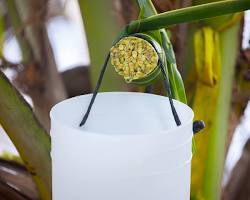
Fresh coconut sap is mostly a dilute sugar solution, but its starting pH already nudges the inversion reaction along before any heat is applied. Those initial conditions set the baseline for everything that happens later in the pot.
Baseline Sucrose Concentrations and Trace Minerals
Sucrose makes up most of the sugar in fresh sap, which is what gets converted during inversion. The sap also carries trace minerals that, in small amounts, affect its conductivity and can influence enzyme activity during processing.
Endogenous Organic Acids and Catalytic Potential
Fresh coconut sap naturally contains organic acids that do more than add flavor. They act as catalysts, driving the acid-catalyzed inversion of sucrose from the moment the sap leaves the tree.
Malic acid and citric acid are present in concentrations high enough to push the sap’s pH below neutral. That acidity starts hydrolyzing sucrose into glucose and fructose before the sap ever touches heat. It’s one of the reasons coconut sap behaves differently from cane juice once you start cooking it down — the inversion clock is already running.
Mechanisms of Acid and Base Catalyzed Inversion
Acid and base catalysts both speed up sucrose inversion, a reaction documented as far back as a 1984 study in the Journal of Food Technology. But they get there through different chemical routes, both involving the same glycosidic bond that holds glucose and fructose together in a sucrose molecule.
Proton-Induced Hydrolysis of Glycosidic Bonds
Acid catalysis works by protonating the glycosidic oxygen, which makes the bond more vulnerable to attack by water molecules. Once that bond breaks, you’re left with separate glucose and fructose.
Alkaline-Mediated Degradation and Isomerization Pathways
Base catalysis takes a different route. It promotes an enediol intermediate that goes through isomerization and fragmentation, a pathway that can also produce other degradation byproducts along the way.
It’s a messier process than acid hydrolysis. The hydroxide ion pulls a proton from the C2 hydroxyl group on the fructose part of the molecule, forming an alkoxide. That alkoxide kicks off a chain of rearrangements, including the enediol step mentioned above, and the resulting intermediate is reactive enough to undergo retro-aldol cleavage and further isomerization. These side reactions are part of why heavily alkaline-cooked coconut sap develops flavor notes that go beyond plain sweetness.
Kinetics of Invert Sugar Formation During Thermal Processing
The rate at which sucrose breaks down into glucose and fructose determines sweetness, texture, and how well the final product crystallizes, so the kinetics are worth paying attention to. For a useful primer on the underlying sugar chemistry, see this chapter on sugar.
Temperature-Dependent Rates of Sucrose Breakdown
Temperature and breakdown rate move together. Push the heat up and inversion happens faster, producing more invert sugar in less time.
Impact of Temperature on Sucrose Inversion Rate
| Lower Temperatures | Slower inversion rate; less invert sugar formed. |
| Higher Temperatures | Faster inversion rate; more invert sugar formed. |
Monitoring Glucose and Fructose Ratio Development
The glucose-to-fructose ratio is a good proxy for how far inversion has progressed, and it has a direct effect on both sweetness and texture in the finished product.
Watching how that ratio shifts during cooking gives you a handle on the inversion level, which in turn lets you dial in a specific taste profile and head off unwanted crystallization. The balance between glucose and fructose drives both sweetness intensity and the texture you end up with.
Impact on Sensory Profiles and Flavor Chemistry
Invert sugars change the sensory experience of coconut sap products in several ways at once: sweetness, mouthfeel, and the flavor compounds that form during cooking. Research on sugar crystal formation covers how this plays out in food texture more broadly. Getting the inversion level right is central to hitting the product characteristics you’re after.
Sweetness Intensity and Perception Thresholds
More fructose and glucose relative to sucrose means a sweeter product, full stop. Inversion lowers the sweetness perception threshold, so less sugar is needed overall to hit the same taste.
Synergistic Effects with Maillard Reaction Products
Invert sugars are also active participants in Maillard reactions, particularly later in the cooking process. That interaction generates a wider range of aroma and flavor compounds than sucrose alone would produce.
Glucose and fructose are reducing sugars, so they react readily with amino acids at high temperatures, speeding up and diversifying Maillard reactions. That’s where pyrazines, furans, and other heterocyclic compounds come from, the nutty, caramel, sometimes malty notes that give cooked coconut sap its depth. Inversion and browning are tangled together here, and that interplay is a big part of what makes the flavor distinctive.
Effects on Crystallization and Structural Integrity
Inversion reshapes the physical character of the finished product. Glucose and fructose change how sucrose crystals form and grow, which in turn determines the texture you end up with.
Inhibition of Sucrose Crystal Nucleation and Growth
A mixed-sugar solution makes it harder for sucrose to crystallize in the first place. Glucose and fructose molecules get in the way of the orderly arrangement sucrose needs to nucleate and grow crystals.
Influence on Solubility, Viscosity, and Hygroscopicity
Invert sugars increase both solubility and viscosity, which shows up as a smoother texture. They’re also more hygroscopic, so the product holds onto moisture better.
Because invert sugars dissolve more readily than sucrose, more sugar can stay in solution in the same amount of water, which helps avoid unwanted crystallization. That same property also gives you a thicker, more viscous syrup or paste, useful for confections. For products like coconut sugar or nectar, where a smooth, non-gritty texture matters, this is one of the main levers. The extra hygroscopicity from glucose and fructose also means the product resists drying out and holds its texture longer.
Process Optimization for Quality Standardization
Consistent quality comes down to controlling the inversion reaction closely. Get the processing parameters right and invert sugar formation becomes predictable, which is what standardizes taste, texture, and shelf life from batch to batch.
pH Buffering Strategies for Controlled Inversion
Adjusting the sap’s pH is one of the main ways to manage inversion. Buffering agents keep the acidic environment stable, which keeps the hydrolysis rate, and the resulting invert sugar levels, predictable from batch to batch.
Thermal Profiling to Balance Texture and Taste
Temperature control affects both how fast inversion happens and what the final product turns out like. A good thermal profile gets the sugar conversion you want without cooking off the delicate flavor notes.
Tracking temperature throughout the cook lets you manage the reaction kinetics with specific heating and cooling curves, which feed into final sweetness, viscosity, and crystallization. Push inversion too far and the product turns out overly sweet and thin. Not far enough, and crystallization problems creep back in. Careful thermal profiling is what keeps a batch in that sweet spot: balanced flavor, right texture.
Final Words
Sucrose inversion is easy to overlook because it’s invisible. There’s no single moment where it “happens.” But it’s quietly doing most of the work that decides whether a batch of coconut sap turns into a smooth syrup or a grainy mess. Get the acid/base balance and temperature right, and the rest of the process gets a lot more forgiving.