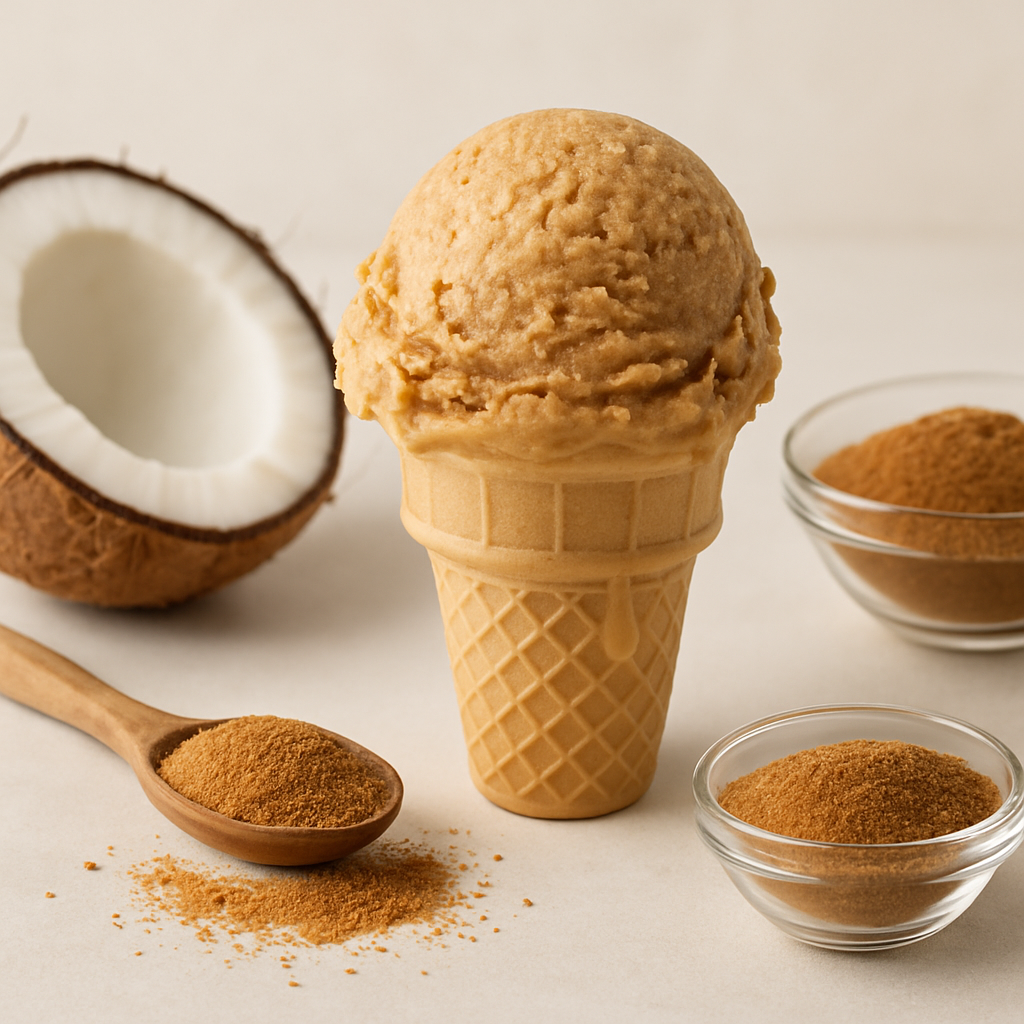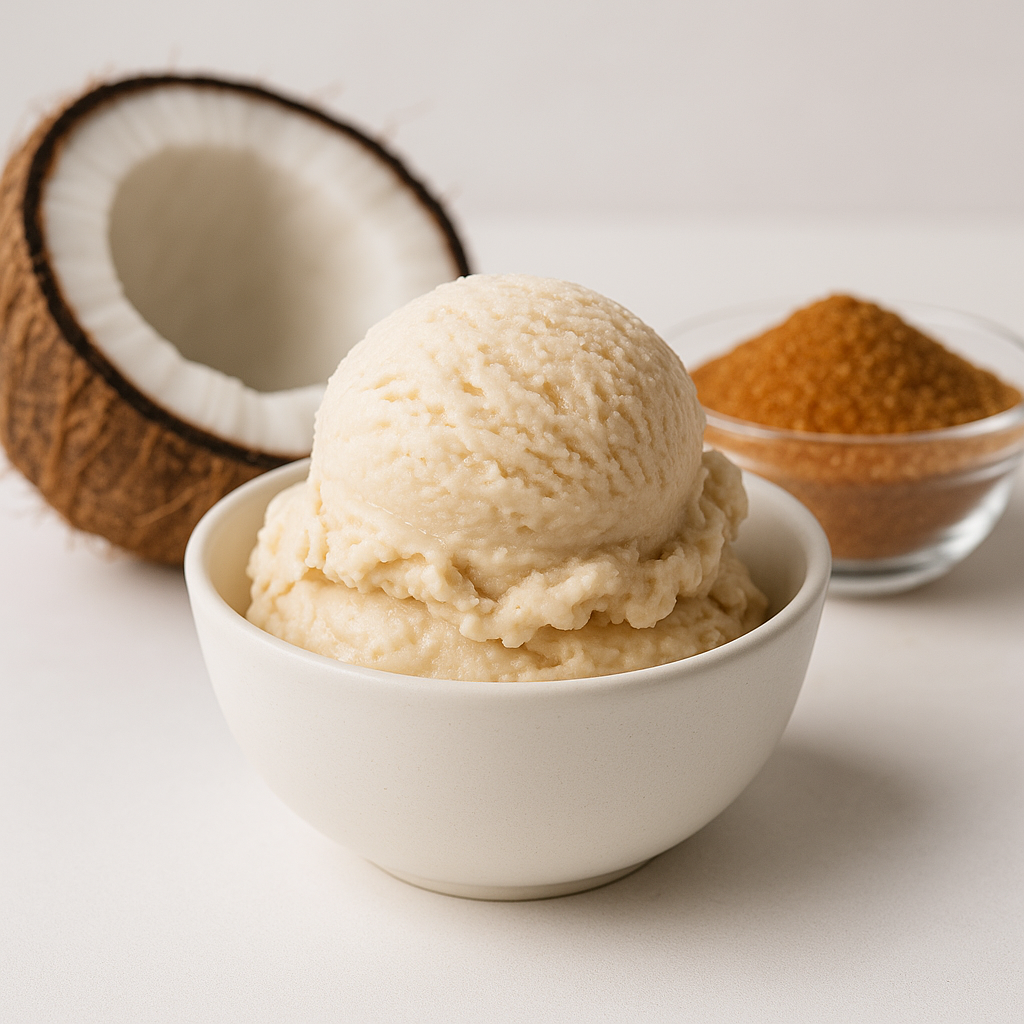
Coconut Sugar in Ice Cream behaves differently than white sugar in an ice cream base because of its molecular composition and mineral content. There’s real chemistry behind why a coconut sugar batch turns out different from a regular one, affecting both freezing point and final texture.
Why does the freezing point even matter?
The freezing point of an ice cream base controls texture and scoopability – it’s the temperature at which water molecules lock into ice crystals. The lower that point, the softer the ice cream stays at typical freezer temperatures.
Nobody wants to eat a literal ice cube
Texture is what separates premium ice cream from frozen disappointment. Without proper freezing point depression, a batch would turn rock-solid at standard freezer temperatures (around -18°C) – more chisel than scoop.
How sugar keeps things nice and soft
Sugar molecules get in the way of water molecules trying to form ice crystals. Dissolved sugar particles interfere with the freezing process, keeping some water liquid even below zero, which is what creates that scoopable consistency.
Water molecules want to link up into a rigid ice structure, but sugar molecules get in the way and prevent that from happening cleanly. The more sugar dissolved in the mix, the harder it becomes for ice crystals to form and grow – so sugar isn’t just adding sweetness, it’s doing real structural work. Different sugars have different molecular weights and properties, so they don’t all depress the freezing point equally. Coconut Sugar in Ice Cream is mostly sucrose with small amounts of fructose and glucose, giving it freezing characteristics that differ somewhat from plain white sugar. Getting the balance right matters – too much depression and the ice cream turns soupy, too little and it’s back to the ice cube problem.
Is it going to be grainy or what?
Graininess shows up with coconut sugar because its larger crystals don’t dissolve as easily as refined white sugar. Base temperature and mixing time make a real difference here.
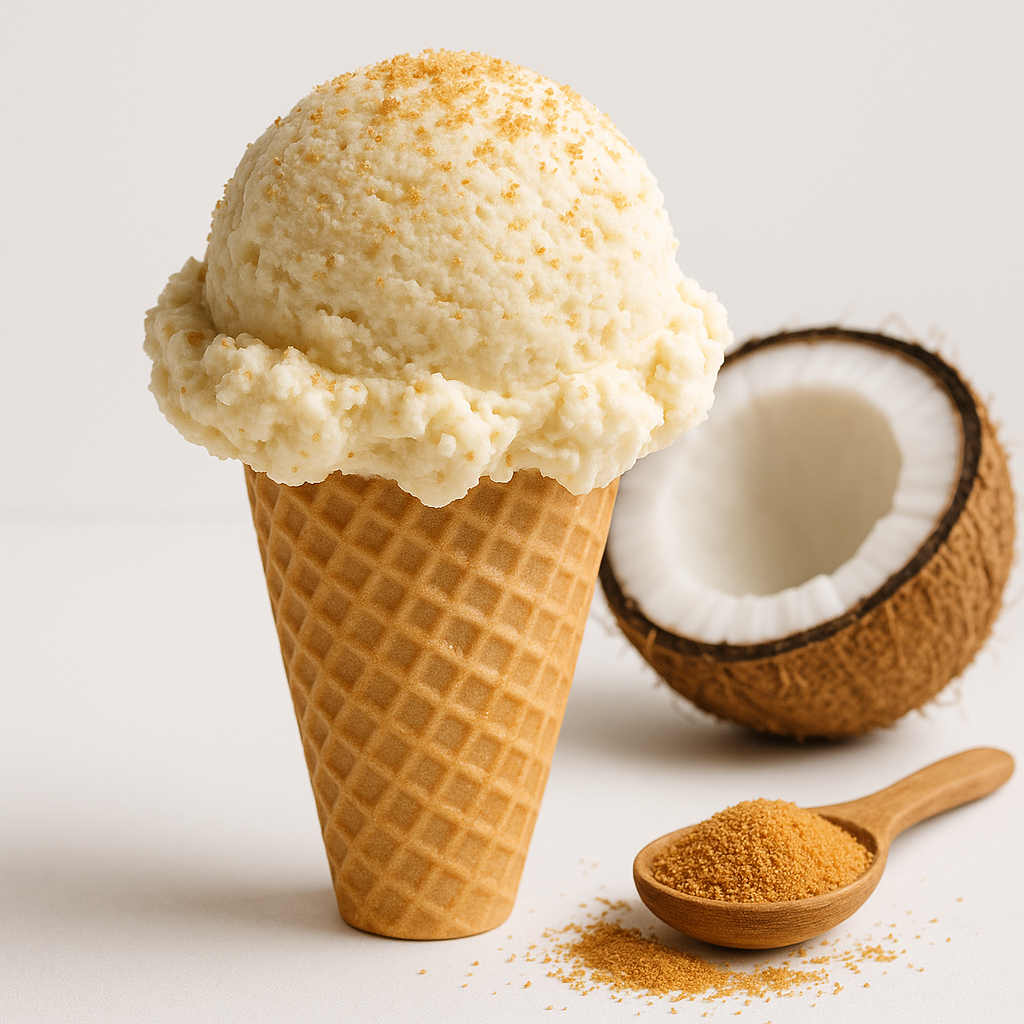
Why coconut sugar can be a bit moody
Coconut sugar behaves differently than refined sugar because of its molasses content and larger particle size – those natural impurities interfere with how it dissolves in the base. Temperature swings during storage can make things worse, causing recrystallization that leads to a gritty texture.
The secret to getting that silky feel
Dissolving coconut sugar completely in warm liquid before adding it to the base prevents most texture issues – heating to around 140-160°F and whisking until no grains remain between the fingers does the trick.
Combining it with glucose syrup or invert sugar tends to give the smoothest texture, since different sugar types interfere with each other’s crystallization. Letting the base age overnight in the fridge gives the coconut sugar more time to fully hydrate and integrate, and some ice cream makers blend the base in a high-speed blender for about 30 seconds before churning – the mechanical action breaks down remaining particles and produces a more homogeneous mixture that freezes into a silkier, more professional texture. The natural caramel and toffee notes become more noticeable once the texture is properly smooth.
My take on the scoop-ability factor
Coconut Sugar in Ice Cream produces a softer texture that’s easier to scoop straight from the freezer – no need to wait the usual ten minutes before serving. The lower freezing point keeps ice crystals smaller, giving it that scoop-shop consistency at home.
Why it melts way faster than you’d expect
A coconut sugar batch will puddle on the plate faster than a regular one. The same properties that make it easy to scoop also mean it can’t hold its shape at room temperature for long – maybe two minutes before it’s soup.
Honestly, don’t leave it on the counter
Leaving a coconut sugar batch out while prepping bowls is asking for trouble – it turns to liquid faster than expected. Better to get everything ready first, then pull it from the freezer.
During a dinner party last summer, three pints of homemade Coconut Sugar in Ice Cream vanilla sat out for maybe three minutes while spoons and toppings got sorted – by the time anyone looked back, the containers were sitting in puddles with that sad, separated look. A regular cane sugar batch made the same day was still perfectly firm.
The rapid meltdown ties back to those dissolved solids – coconut sugar has more interfering molecules that prevent water from refreezing quickly once melting starts. A standard ice cream might slowly soften and give some leeway, but Coconut Sugar in Ice Cream versions cross the point of no return almost instantly. Treating it like gelato – scoop fast, serve immediately, back in the freezer quickly – avoids the mess.
Seriously, let’s talk about the science
Molecular interactions between sugar and water determine everything about an ice cream’s texture. Coconut sugar behaves differently than pure sucrose because of its mixed composition – sucrose, fructose, and glucose all present at once. The freezing point depression depends on how many individual molecules are floating around in the base, not just the total weight of sweetener.
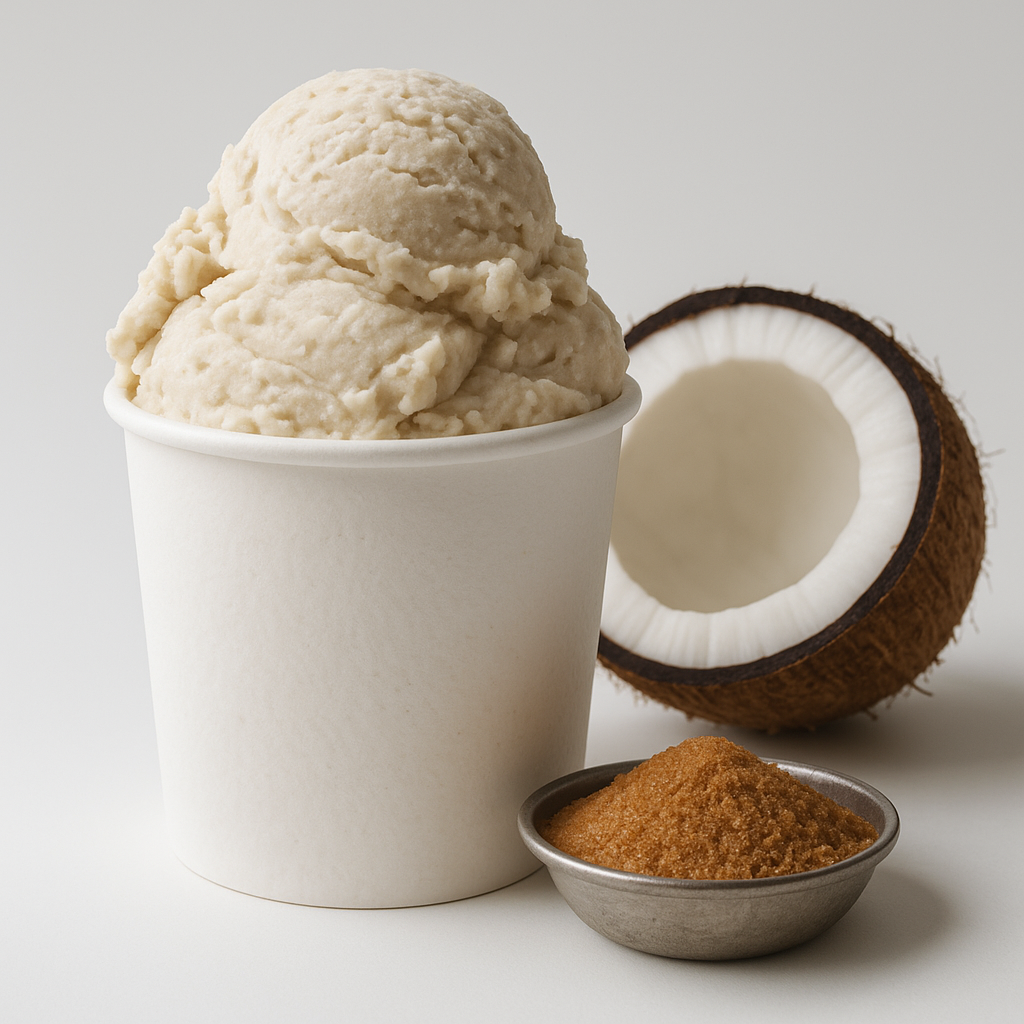
The truth about molecular weight and ice
Smaller molecules create more freezing point depression per gram than larger ones. The glucose and fructose in coconut sugar (molecular weight around 180) are more effective at preventing ice crystal formation than pure sucrose (molecular weight 342) – which translates to a softer result at the same sweetness level. Understanding sucrose inversion and invert sugar formation helps explain why these smaller molecules behave differently in frozen applications.
Why it’s different from using honey or maple
Honey and maple syrup bring water content that throws off an ice cream base’s ratios, while coconut sugar stays dry and granular, putting hydration control in the maker’s hands. The moisture difference alone changes the whole formulation approach when switching between liquid and dry sweeteners.
Adding honey or maple introduces roughly 15-20% water along with the sugars, and that water is free to freeze into ice crystals unless it’s accounted for in the recipe. Coconut sugar starts as a dry ingredient with only about 2-3% moisture – related to its water activity and storage stability – which gives more control over the final water-to-solids ratio.
Mineral content plays a role too – the potassium, magnesium, and other minerals in coconut sugar interfere with ice crystal formation in ways pure sugar doesn’t, offering a slight textural edge from those trace elements alone. Honey carries its own enzymes and acids that can affect dairy proteins over time, and maple syrup’s distinctive flavor can overpower a delicate base – Coconut Sugar in Ice Cream adds sweetness and texture modification without dramatically altering flavor or protein stability.
Pro tips for a better batch
A few techniques separate okay results from spectacular ones: keep the base mixture cold before churning to speed up freezing and create smaller ice crystals, bloom the coconut sugar in warm liquid first to dissolve it completely and prevent graininess later, and taste the mixture before churning since frozen desserts taste less sweet than their liquid form – the subtle caramel notes come through more easily at serving temperature.
Here’s how to balance your recipe
Coconut sugar can replace regular sugar at a 1:1 ratio, but reducing total sweetener by 10-15% accounts for how much sweeter it tastes once frozen. A tablespoon of alcohol or corn syrup helps prevent rock-hard scoops.
What to do if it’s just not working
Troubleshooting starts with identifying the problem. Ice crystals forming usually means too much water or not enough fat; a sandy texture means the sugar didn’t fully dissolve – heating the base more thoroughly before cooling fixes that next time.
A batch that froze too hard probably had too much coconut sugar relative to fat, throwing off the freezing point depression – tempering at room temperature for 5-10 minutes, or 10-second bursts in the microwave, can help. A grainy result means the coconut sugar didn’t fully dissolve, which calls for heating the base to at least 170°F next time and stirring until every granule disappears. A batch that’s soupy and won’t freeze properly likely has too much alcohol, or the freezer isn’t cold enough – it should be at 0°F or below. Even a failed batch isn’t a total loss – it can usually be repurposed into milkshakes or ice cream sandwiches.
The Bottom Line
Coconut Sugar in Ice Cream offers a natural alternative that changes both texture and freezing behavior in ways worth understanding before diving in. Its freezing point depression differs from regular sugar due to mixed molecular composition, the mineral content affects crystal formation throughout the batch, and larger particle size requires careful dissolution to avoid graininess. Success comes down to understanding these properties: dissolving coconut sugar completely in warm liquid before churning, adjusting total sweetener down by 10-15% to account for enhanced sweetness perception when frozen, and serving promptly since the softer texture also means faster melting at room temperature. The same moisture sensitivity that requires careful storage also affects how it performs in frozen applications.