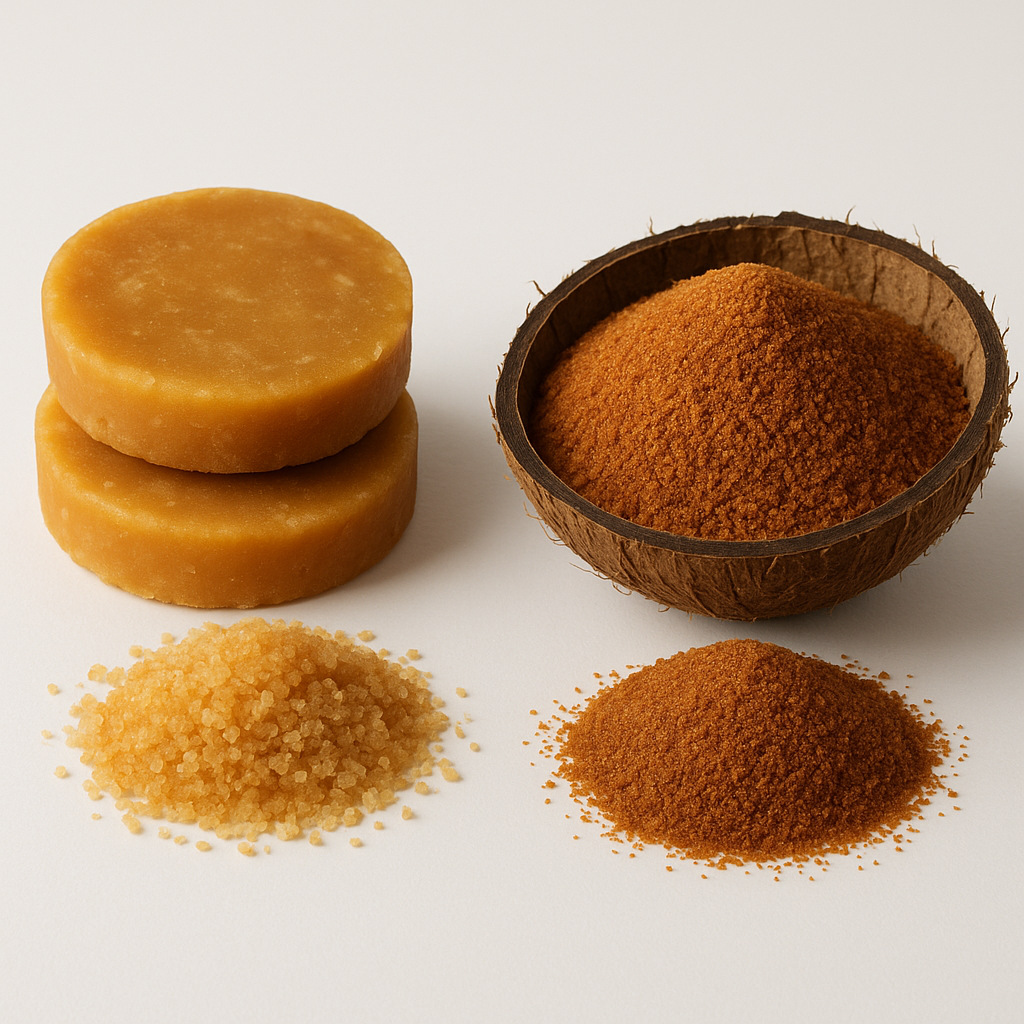
With coconut sugar showing up in everything from keto brownies to cold brew, it’s natural to wonder whether it’s just palm sugar with better marketing. The short answer to the question “Palm Sugar vs. Coconut Sugar”: not quite, though the confusion is understandable — the labels really don’t help.
Here’s the thing that trips most people up: all coconut sugar is technically palm sugar, but not all palm sugar comes from coconut palms. It depends on which tree the sap was tapped from — sugar palm, date palm, nipa palm, or the coconut palm. So the two are more like cousins than twins.
Wait, aren’t they actually the same thing?
It’s easy to assume palm sugar and coconut sugar are interchangeable — plenty of recipes and labels treat them that way. But they aren’t quite the same, even when some brands blur the line. Both come from palm trees and go through similar processing, but the source, flavor, and nutritional profile differ more than most people expect.
Why the names are so confusing
The overlap in naming probably comes down to the fact that both sugars come from palms. Coconut sugar specifically comes from the sap of coconut tree flowers, while palm sugar can come from a range of palm species — date, palmyra, and others. That overlap is exactly why the distinction trips people up at the grocery store.
The truth about what’s on the label
Labeling doesn’t always reflect what’s inside the bag. Plenty of products marked “coconut sugar” actually contain generic palm sugar, especially outside Southeast Asia. Loose labeling rules mean manufacturers often use the terms interchangeably, even though the source affects both taste and origin. Checking the source matters if authenticity is a priority.
Regulatory standards for sugar labeling aren’t exactly tight, either. In the U.S. or Europe, a bag marked “coconut sugar” might be blended with other palm saps or mislabeled outright. That granulated sweetener in the pantry could be from a coconut flower — or it might not be. The distinction goes beyond semantics: it affects flavor, sustainability, and how ethically the product was sourced. For anyone cooking or baking with intention, that’s a difference worth knowing.
What’s the real deal with coconut sugar?
Coconut sugar shows up constantly in health food stores and trendy recipes, but it’s not just marketing. There are real differences between it and other palm sugars, even when they look similar on the shelf. The source, taste, and processing all tell a different story once you look closer.
It’s all about those coconut blossoms
Coconut sugar comes from the sap of coconut palm blossoms — not the fruit, which surprises a lot of people. Farmers tap the flower buds and collect the sweet nectar as it flows out, then heat that syrup to evaporate the water and leave behind granules. Both coconut sugar and palm sugar come from palms, but the specific tree and the part that’s tapped make a real difference.
How it’s made without all the junk
Coconut sugar skips the heavy processing found in regular table sugar — it’s essentially just sap boiled down, with no chemicals or additives involved. Because it’s minimally refined, it retains more of its natural nutrients, including small amounts of iron, zinc, and antioxidants. That simplicity is where coconut sugar really stands out.
It’s a bit like homemade jam versus a store-bought version with ten ingredients no one can pronounce. The process starts with a farmer climbing a coconut palm by hand and slicing into the flower cluster to let the sap drip out. That sap gets collected daily, then slowly simmered down in large pans — no centrifuges, no bleaching, nothing artificial. What’s left is a caramel-colored granule that tastes like brown sugar’s earthier cousin. And despite how often Palm Sugar vs. Coconut Sugar get compared, coconut sugar is really just one type of palm sugar — other varieties come from date, sago, or nipa palms, each with its own flavor. Knowing that helps cut through a lot of the labeling noise.
So, what is palm sugar anyway?
Palm sugar isn’t one single thing — it’s a catch-all term for any sugar made from the sap of palm trees, collected, boiled, and crystallized. It often gets lumped together with coconut sugar, but depending on the tree and region, the flavor, color, and texture can vary quite a bit.
It comes from a bunch of different trees
Coconut palms aren’t the only source — palm sugar can be tapped from date, palmyra, or nipa palms depending on the region, often somewhere in Southeast Asia or Africa. That means a bag labeled “palm sugar” might come from an entirely different tree than expected, which is a big part of why the category gets confusing.
Why it doesn’t always look the same
One batch of palm sugar might look golden and crumbly while another is dark and sticky — and that’s down to the sap source, boiling time, and how it’s cooled, not a sign that something’s off. Natural variation is just part of how this sugar is made.
Some people assume darker palm sugar is lower quality, but it’s usually the opposite — a deeper color generally means longer boiling, which concentrates the caramel-like flavors. A rich, molasses-y palm sugar gets that depth from careful cooking, not from being inconsistent. Even within the same harvest, batches can vary, and that’s normal for something that isn’t factory-made. This natural range matters most when baking or balancing flavors — neither version is better, just different, and it’s worth picking the one that suits the recipe.
Here’s why they aren’t actually twins
A bag labeled “palm sugar” might look like coconut sugar at a glance, but they come from different trees and go through slightly different processing. Both are natural sweeteners, but they’re not always interchangeable in recipes.
The big difference in how they taste
The flavor difference shows up the moment a spoonful hits a cup of tea. Palm sugar tends to bring a richer, more floral sweetness with hints of caramel, sometimes leaning fruity or even wine-like depending on the source. Coconut sugar, by comparison, leans smoky and butterscotch-like. It’s not a subtle difference — it changes how a finished dish tastes. Understanding volatile aroma compounds can explain why these toffee-like qualities emerge.
Why one is way easier to find
Walk into a mainstream grocery store and coconut sugar is far easier to spot than palm sugar. Coconut sugar won the labeling battle and hit mainstream shelves first, while palm sugar often hides under regional names or stays in ethnic markets.
Coconut sugar became a health food favorite quickly, helped along by glycemic index claims and trendy branding. Palm sugar, despite being just as traditional, never got that same marketing push. So even though Palm Sugar vs. Coconut Sugar get compared constantly among foodies and nutrition-focused cooks, availability still skews heavily toward coconut sugar — and without looking in the right aisle, it’s easy to never encounter palm sugar at all.
My take on cooking with these two
Standing in the baking aisle, it’s worth asking whether the choice actually matters. Both bring deep caramel notes, but palm sugar leans smokier while coconut sugar is milder, almost nutty. Palm sugar works well for boldness in curries or sticky glazes, while coconut sugar is a better fit for muffins or granola. Texture plays a role too — coconut sugar dissolves faster, which matters more than it seems.
Which one wins in a cookie recipe?
Coconut sugar is the better pick for cookies, plain and simple. It blends smoothly into dough without grit, and its subtle sweetness doesn’t compete with butter or chocolate. Palm sugar can add an interesting depth, but it can also push chocolate chip cookies toward tasting like they wandered into a curry. Coconut sugar is the safer bet here.
Can you just swap them 1-for-1?
Swapping one for the other isn’t always a clean substitution. They may look similar, but their moisture content and flavor intensity differ — coconut sugar is drier and milder, while palm sugar brings more punch and stickiness. In some dishes, a straight swap works fine. In others, the difference shows up clearly.
It’s a bit like swapping dark and light soy sauce — similar role, different impact. In a sauce or stew, swapping one for the other is usually fine. In baking, where the chemistry matters more, the extra moisture in palm sugar can throw off texture, leading to cookies that spread too much or cakes that sink. When substituting, using slightly less palm sugar and trimming other liquids a touch helps, and tasting as you go is always a good idea. Granulation matters too — finely ground coconut sugar integrates faster than chunky palm crystals, so a quick blitz in a grinder helps if the palm sugar isn’t already powdered.
Is one honestly better for your health?
Coconut sugar and palm sugar both sit around 35-54 on the glycemic index, which makes them slower-burning than table sugar — but that’s not really cause for celebration. They’re still sugars. Some claims point to one having more minerals than the other, but the differences are tiny in real-world serving sizes.
Let’s talk about the glycemic index
Some sources cite coconut sugar at a glycemic index of 35, as if that’s a free pass to eat it by the spoonful, but actual lab tests vary and have measured it as high as 54. Palm sugar isn’t much different, ranging from roughly 35 to 50. Neither causes the rapid spike that white sugar does, but both still raise blood glucose. On this front, Palm Sugar vs. Coconut Sugar are practically twins. Learn more about why GI values vary across studies.
Why ‘natural’ doesn’t mean it’s a superfood
Coming from a tree doesn’t automatically make something health food. Coconut sugar gets praised for being “natural,” but so is maple syrup, and nobody’s drinking a pint of that daily. Both sugars still contain calories and fructose, and both can affect insulin. Calling one better simply because it’s less processed skips over the basic nutrition facts — “natural” here is more about marketing than anything else.
Calling either of these a superfood is a stretch — sure, coconut sugar has trace amounts of potassium or iron, but getting a meaningful amount would mean eating far more sugar than anyone should in one sitting. The body processes sugar the same way regardless of whether it came from a flower bud or a sap stream. Neither one is a free pass to overindulge, no matter how it’s marketed.
The Bottom Line
So are Palm Sugar vs. Coconut Sugar the same thing? Not quite — they come from different trees, undergo slightly different processing, and bring distinct flavors and textures to the table. Coconut sugar comes specifically from coconut flower nectar, while palm sugar is a broader category that can come from several different palms. They’re related, but each brings something different to a recipe — and knowing which one is actually in the bag makes a real difference. Whether you’re formulating a new product line or adjusting a home recipe, understanding the nuances between these two helps you pick the right one for the job.