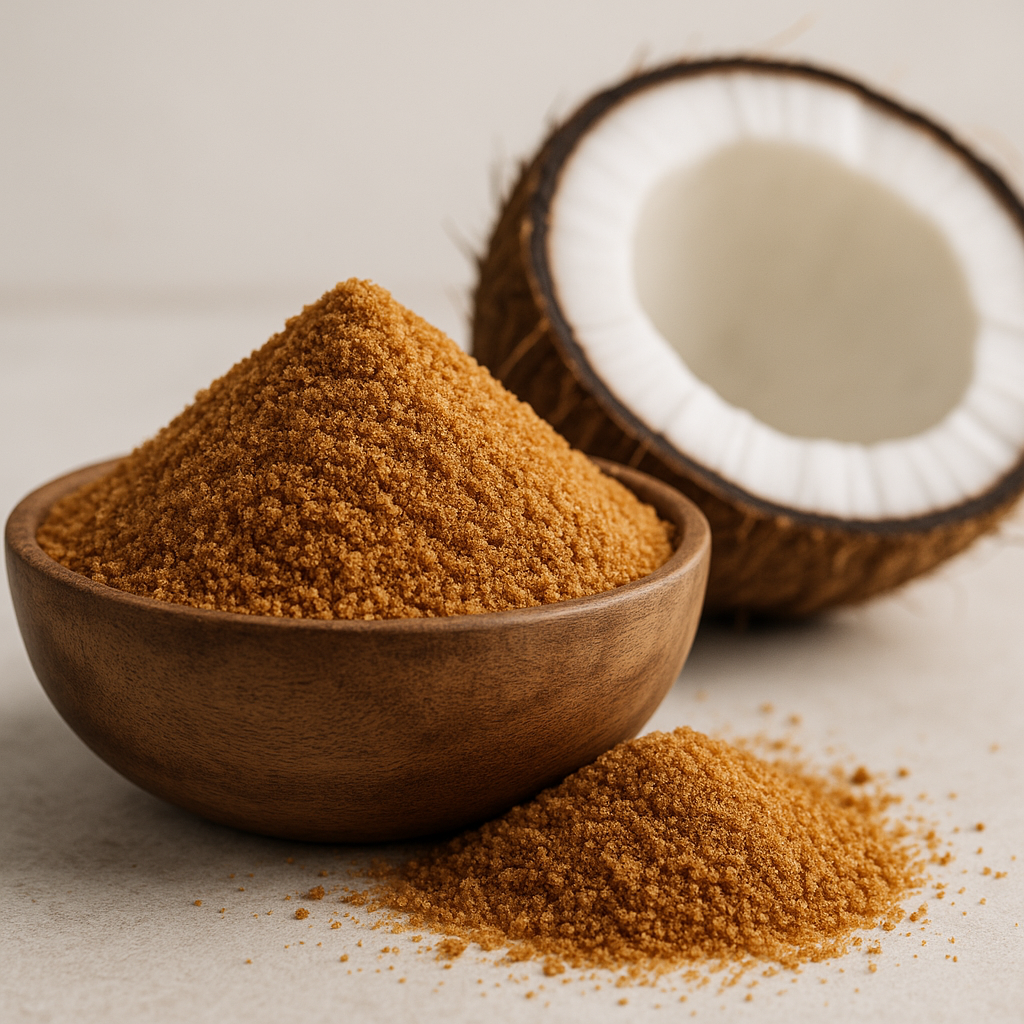
Choosing the wrong coconut sugar particle size can create unexpected problems in food production. Fine granules may dissolve quickly in certain formulations, while coarser crystals can provide a different texture and visual appearance. For manufacturers, bakeries, beverage producers, and ingredient distributors, these differences can affect mixing, product consistency, and processing efficiency.
However, coconut sugar granulation is not simply a choice between fine and coarse crystals. The right particle size depends on how you use the ingredient, how your production equipment handles it, and the consistency your final product requires.
This guide explains the main coconut sugar particle size considerations, how granulation affects food applications, and what buyers should confirm with a supplier before placing a bulk order.
1. What Is Coconut Sugar Granulation?
Coconut sugar granulation refers to the size and distribution of particles in the finished product. Producers obtain coconut sugar from the sap of coconut palm flowers through processing that includes heating to concentrate the sap and form sugar crystals or granules.
The resulting product can contain particles of different sizes. Some batches have a relatively fine, uniform texture, while others contain a broader distribution of granules. Processing and screening methods influence the final particle profile.
Particle size versus crystal consistency
Particle size describes how large or small individual granules are. Particle size distribution describes the range of sizes within a sample.
Both characteristics matter. Two coconut sugar products may look similar at first glance but behave differently during mixing or dissolution because their particle distributions differ.
Buyers should therefore avoid relying on descriptions such as “fine,” “medium,” or “coarse” alone. These terms can vary between suppliers.
Instead, ask for the supplier’s granulation specifications, including any available particle size ranges, screening criteria, or sieve analysis results. If your production process requires a narrow size range, make that requirement explicit before approving the product.
2. What Are the Main Coconut Sugar Particle Size Options?
Coconut sugar suppliers may offer different granulation profiles, although the available grades and terminology vary by producer. The following categories provide a practical starting point for discussing your requirements.
Fine coconut sugar
Fine granules have smaller particles and may disperse more readily in some mixtures. They can suit applications where manufacturers want a relatively smooth ingredient texture or consistent distribution throughout a dry blend.
Potential applications include:
- Dry beverage and drink-mix formulations
- Fine bakery premixes
- Powdered food blends
- Products that require relatively uniform ingredient distribution
However, smaller particles do not automatically guarantee better dissolution or smoother processing. Moisture, temperature, formulation, and mixing conditions also influence performance.
Medium-granulated coconut sugar
Medium granules can offer a practical balance between handling and incorporation into many food formulations. Depending on the supplier’s specifications, this type may suit general food manufacturing, bakery recipes, and selected dry mixes.
Nevertheless, “medium” does not represent a universal particle size. Ask the supplier to define the grade numerically or through an agreed screening specification when consistency matters.
Coarse coconut sugar
Coarser granules have larger particles and may create a more noticeable texture before they dissolve or blend into a product.
Possible applications include selected dry blends, recipes that accommodate larger granules, and products where the ingredient’s visible texture matters. However, coarse granules may take longer to dissolve under certain conditions and may not distribute evenly in every formulation.
The best granulation is the one that meets your product requirements, rather than the one with the smallest or largest particles.
3. How Does Particle Size Affect Food Manufacturing?
Granulation can influence several production characteristics. Understanding these effects helps manufacturers select a suitable grade and reduce unnecessary formulation adjustments.
Dissolution and mixing
Smaller particles generally provide more surface area relative to their mass. As a result, they may dissolve or disperse faster under comparable conditions.
However, dissolution also depends on water temperature, agitation, ingredient concentration, and the composition of the surrounding mixture. Fine particles can also form clumps if moisture or mixing conditions encourage agglomeration.
Before selecting a grade for beverages or liquid products, test it under your actual processing conditions.
Texture and appearance
Particle size affects how an ingredient feels and looks in the finished product. In dry blends, granulation can influence uniformity and the appearance of the mixture. In recipes where sugar remains partly undissolved, larger particles may create a more noticeable texture.
For bakery products, the impact depends on the recipe, mixing process, and baking conditions. A particle size that works well in one dough or batter may not produce the same result in another.
Flowability and handling
Particle size distribution can affect how freely coconut sugar moves through hoppers, feeders, and packaging equipment. Nevertheless, flowability also depends on moisture, particle shape, fines content, and storage conditions.
If you use automated equipment, evaluate the product for bridging, clumping, inconsistent feeding, or dust generation. These observations can help you determine whether the supplier’s granulation suits your production line.
4. How to Choose the Right Granulation for Your Application
The most effective selection process starts with your finished product and works backward to the ingredient specification.
For beverages and powdered drink mixes
Consider how quickly the sugar must dissolve or disperse and whether the formulation contains other powders that may affect mixing. Fine granulation may help in some applications, but verify the result through dissolution and stability tests.
For bakery and confectionery
Assess how the granules interact with flour, fats, liquids, and other ingredients. The ideal particle size depends on the recipe, mixing time, desired texture, and manufacturing method.
For example, a dry bakery premix may require a different granulation profile from a formulation in which the sugar dissolves during mixing or heating.
For dry blends and ingredient distribution
Uniform particle size can help reduce visible separation between ingredients with different physical characteristics. However, differences in particle density, shape, and handling can also cause segregation.
Test the complete blend rather than evaluating coconut sugar in isolation.
For retail or specialty food products
Appearance, mouthfeel, and the intended consumer experience may influence the choice. In these cases, sample testing helps confirm whether the selected granulation supports the product’s intended characteristics.
Before ordering, define the key acceptance criteria. These may include particle size range, acceptable variation between batches, moisture limits, and performance during processing.
5. What Specifications Should Buyers Request From a Supplier?
A product description rarely provides enough information for a consistent bulk purchasing decision. Buyers should request technical details that connect granulation to measurable quality requirements.
Ask your coconut sugar supplier for:
- Particle size specification: Request the stated size range or grade definition.
- Particle size distribution: Ask whether the supplier can provide sieve analysis or another suitable measurement.
- Moisture specification: Moisture can influence clumping, storage stability, and handling.
- Appearance and sensory characteristics: Confirm the expected color, aroma, and flavor.
- Batch consistency: Ask how the supplier maintains granulation across repeat orders.
- Packaging and storage guidance: Confirm how the product should be protected from moisture and handled after delivery.
- Quality documentation: Request the technical data sheet and relevant batch documentation.
If granulation is critical to your process, specify an acceptable tolerance rather than simply requesting “fine coconut sugar.” Also, confirm whether the supplier can maintain that specification for recurring orders.
For buyers exploring Indonesian ingredients, OilCocos provides information about its product offerings. You can also review the coconut sugar supplier from Indonesia page and discuss the available specifications for your application.
6. How to Test and Approve Coconut Sugar Granulation Before Ordering
A sample evaluation helps determine whether a product meets your actual production needs. Ideally, test the sample using the same equipment, recipe, and process conditions you expect to use at scale.
Use a practical approval process
- Inspect the sample. Check its appearance, texture, visible particle variation, and signs of clumping.
- Review the documentation. Compare the supplier’s specifications with your purchasing requirements.
- Run an application test. Evaluate mixing, dissolution, flow, texture, or other relevant performance characteristics.
- Record the results. Document the batch reference, test conditions, observations, and acceptance decision.
- Confirm repeat-order requirements. Agree on the granulation specification and how the supplier will manage deviations.
Where particle size requires precise control, consider a suitable sieve analysis or laboratory measurement. The method should match the specification and the way your production process responds to particle variation.
Once you approve a sample, retain the agreed specifications in your purchase records. This gives both parties a clear reference when reviewing future deliveries.
Frequently Asked Questions
1. What is the best particle size for coconut sugar?
There is no single best size for every application. Fine granules may suit some powdered mixes, while medium or coarse granules may work better for other recipes. Choose based on processing requirements and sample testing.
2. Does fine coconut sugar dissolve faster than coarse coconut sugar?
Fine particles generally have more surface area relative to their mass and may dissolve faster under comparable conditions. Water temperature, agitation, moisture, and formulation also affect dissolution.
3. Is coconut sugar granulation the same across all suppliers?
No. Suppliers may use different grade definitions, screening methods, and particle size ranges. Request a documented specification instead of relying only on labels such as fine or medium.
4. How can I check coconut sugar particle size?
Start with the supplier’s technical data sheet and particle size specification. If tighter control is necessary, request sieve analysis or conduct an appropriate particle size test.
5. What should I ask a coconut sugar supplier before bulk ordering?
Confirm the particle size range, distribution, moisture specification, batch consistency, packaging, storage guidance, and available quality documentation. Test a representative sample before approving a large order.
Final Considerations
Selecting the right coconut sugar granulation helps align ingredient performance with your formulation, production equipment, and finished-product requirements. Rather than choosing a grade based on appearance alone, define measurable specifications and test the ingredient under realistic conditions.
If you are sourcing coconut sugar for food manufacturing or distribution, discuss your intended application and granulation requirements with your supplier before ordering. This approach helps establish clearer expectations and supports more consistent purchasing decisions.