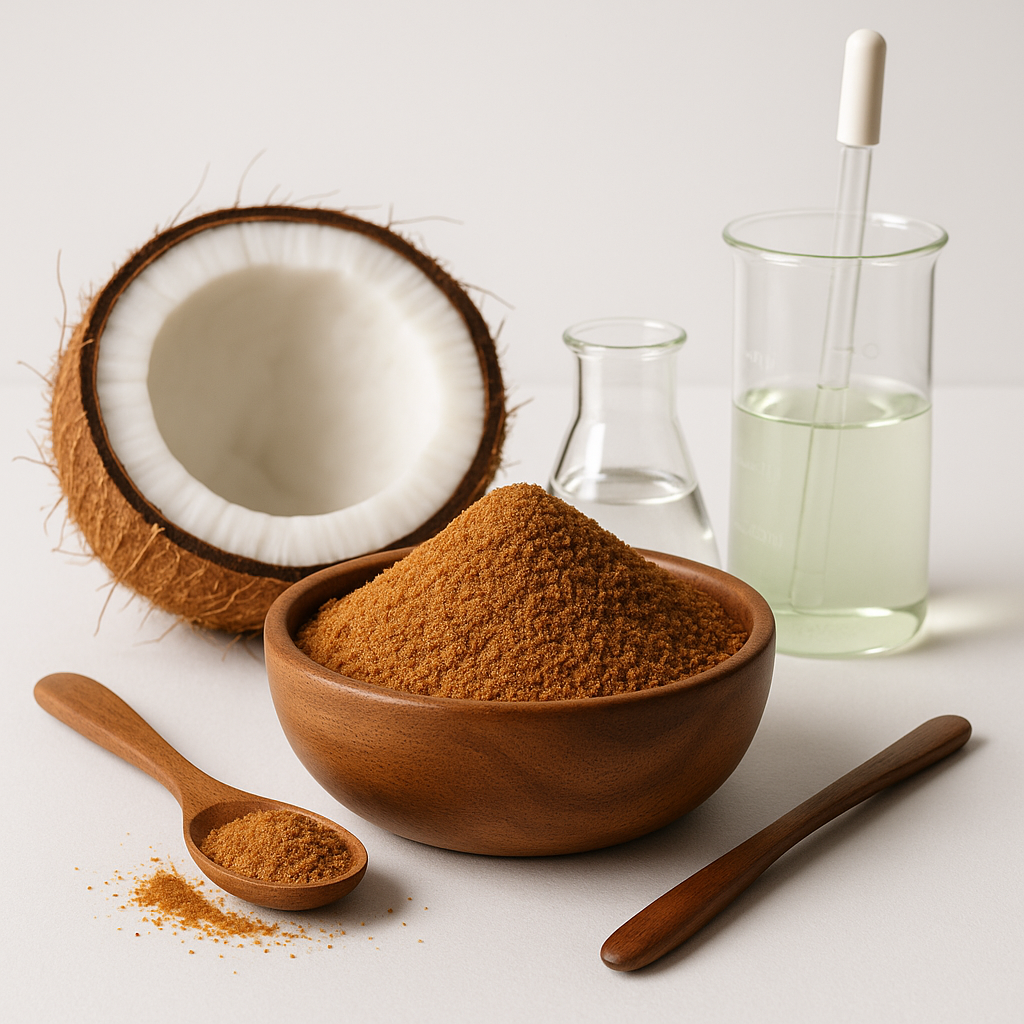
Choosing MCT oil for food, nutrition, cosmetic, or other formulations requires more than checking whether a product is labeled “MCT.” Different products can contain different proportions of medium-chain fatty acids, and those differences can affect the product’s composition, physical characteristics, and intended use.
MCT Oil generally refers to oils rich in medium-chain triglycerides, particularly triglycerides containing caprylic acid (C8) and capric acid (C10). Manufacturers therefore need to look beyond the product name and evaluate fatty acid composition, purity, processing, sensory characteristics, and documentation.
For bulk buyers, understanding C8 and C10 can make product specifications easier to interpret and can help ensure that the selected ingredient matches the requirements of the finished product.
What Is MCT Oil?
MCT stands for medium-chain triglyceride. MCTs are triglycerides containing medium-chain fatty acids, generally in the C6–C12 range. Commercial MCT products commonly focus on C8 and C10 triglycerides.
A scientific review describes MCTs as a family of triglycerides containing predominantly caprylic (C8) and capric (C10) fatty acids, with smaller amounts of other medium-chain fatty acids depending on the product.
Unlike ordinary coconut oil, which contains a broader mixture of fatty acids, commercial MCT oils undergo additional processing to concentrate selected medium-chain components.
Coconut oil and palm kernel oil can serve as feedstocks for MCT production, after which manufacturers separate and process the relevant fatty acids or triglycerides to achieve the desired composition.
This distinction is important for buyers. MCT oil and coconut oil are related, but they are not interchangeable products.
MCT Oil: Why C8 and C10 Matter
C8 and C10 refer to the number of carbon atoms in the fatty acid chain.
C8: Caprylic Acid
C8 refers to caprylic acid, also known as octanoic acid.
MCT products with a high proportion of C8 triglycerides are often selected when manufacturers specifically require a concentrated caprylic component.
For a buyer, the key question is not simply whether a product contains C8. Instead, the buyer should determine the percentage specified in the product’s technical documentation.
C10: Capric Acid
C10 refers to capric acid, also known as decanoic acid.
C10 is another major component of commercial MCT products. Depending on the intended application and manufacturing process, a product may contain a combination of C8 and C10 triglycerides.
Therefore, a buyer should review the complete composition rather than assuming that all MCT oils have the same C8-to-C10 ratio.
Why the Ratio Matters
The C8/C10 profile can influence how manufacturers classify and use an MCT ingredient.
For example, a formulation that requires a specific fatty acid composition may need tighter C8 and C10 specifications than a general-purpose application.
Consequently, buyers should define the desired composition before comparing suppliers.
How MCT Oil Is Produced
Commercial MCT oil requires controlled processing to obtain the desired medium-chain triglyceride composition.
The production route can vary, but it generally starts with a suitable source of medium-chain fatty acids and uses separation and esterification processes to produce triglycerides with the required characteristics. Recent scientific literature describes industrial MCT production through chemical or enzymatic esterification of caprylic and capric acids.
Feedstock Selection
Coconut oil and palm kernel oil are important feedstocks because they contain significant amounts of medium-chain fatty acids.
However, the composition of the original oil does not automatically define the composition of the finished MCT product.
Additional processing allows manufacturers to concentrate and combine selected components according to the target specification.
Separation and Concentration
Manufacturers can separate fatty acids according to their chemical and physical properties.
This step helps create a more controlled mixture of medium-chain components.
The degree of concentration depends on the product specification. Therefore, buyers should always review the actual analytical composition rather than infer it from the feedstock.
Esterification
Selected fatty acids can then combine with glycerol to form triglycerides.
The resulting MCT product can contain predominantly C8, predominantly C10, or a combination of both, depending on the manufacturing target.
What Makes a High-Quality MCT Oil?
Quality involves more than the percentage of C8 and C10.
A complete assessment should consider several characteristics.
Fatty Acid Composition
Composition is one of the most important parameters because it identifies what the product actually contains.
Depending on the application, buyers may request information about:
- C6 content
- C8 content
- C10 content
- C12 content
- Other fatty acids
- Total medium-chain triglyceride content
The acceptable range depends on the product specification.
Purity
Purity indicates how closely the finished product matches its intended composition and quality requirements.
For a concentrated MCT ingredient, buyers may want to understand the presence of unwanted fatty acids, residual processing materials, moisture, and other potential impurities.
A supplier should define the relevant limits in the product specification.
Acid Value and Free Fatty Acids
Acid value or related free-fatty-acid measurements can provide useful information about the condition of an oil or fat.
The appropriate analytical parameter depends on the product specification and testing method.
Buyers should therefore compare supplier results against a defined specification rather than interpreting a value without context.
Peroxide Value
Peroxide value helps assess primary oxidation products.
Although MCT oils have characteristics that can support good oxidative stability, storage and handling still matter. Buyers should therefore include appropriate oxidation-related specifications when relevant to their application.
How Processing Affects MCT Oil Quality
Processing determines more than composition. It can also influence clarity, odor, purity, and consistency.
Distillation and Separation
Separation processes help concentrate specific fatty acids.
Effective control can improve consistency between production batches and help manufacturers achieve the intended C8/C10 profile.
Refining and Purification
Additional purification steps can help reduce unwanted components and produce a cleaner ingredient.
The exact process depends on the target specification and intended use.
Deodorization
For applications where sensory neutrality matters, manufacturers may use controlled processing to reduce unwanted odor or flavor compounds.
This can be relevant to food and nutrition formulations where the MCT oil should not introduce an unexpected sensory profile.
How to Evaluate MCT Oil Specifications
A technical specification gives buyers a practical framework for comparing products.
Before purchasing in bulk, review:
- C8 percentage
- C10 percentage
- Other fatty acid limits
- Appearance
- Odor and flavor
- Acid value or FFA
- Peroxide value
- Moisture or water content
- Purity requirements
- Packaging
- Storage conditions
- Applicable certifications
The exact list should reflect the intended application.
Check the Certificate of Analysis
A Certificate of Analysis (COA) provides batch-specific analytical results.
When reviewing one, compare the actual values with the agreed product specification. Also check the batch number, analytical date, units, and test methods where available.
A single compliant result does not necessarily demonstrate long-term supply consistency. Reviewing results from multiple batches can provide a stronger indication of process control.
MCT Oil for Food, Nutrition, and Other Applications
MCT oils have applications across several industries because of their composition and physical characteristics.
Scientific literature describes their use in food, pharmaceutical, and cosmetic applications.
Food Applications
Food manufacturers may use MCT oil in products where a liquid fat with a specific medium-chain triglyceride composition fits the formulation.
The required C8/C10 profile depends on the product and its formulation objectives.
Nutrition Applications
MCTs also appear in specialized nutrition products. However, nutrition products can have additional compositional, labeling, and regulatory requirements.
Manufacturers should therefore establish specifications that address the particular market and product category.
Cosmetic and Other Applications
MCT-based ingredients can also appear in cosmetic formulations and other applications where properties such as low viscosity, sensory characteristics, and compatibility with other ingredients matter.
Again, the appropriate specification depends on the finished product.
How to Choose an MCT Oil Supplier
A supplier should provide enough technical information for a buyer to evaluate the product objectively.
Useful documentation can include:
- Technical specification sheet
- Certificate of Analysis
- Fatty acid composition
- C8/C10 specification
- Quality-control information
- Relevant certifications
- Packaging details
- Storage recommendations
- Batch traceability
For businesses sourcing MCT oil from Indonesia, OilCocos provides MCT oil alongside other coconut-based ingredients. Buyers can discuss their intended application and required composition before evaluating a sample or establishing a purchasing specification.
The most practical approach is to define the required C8/C10 profile and other quality parameters first, then compare supplier documentation against those requirements.
Common Mistakes When Buying MCT Oil
Assuming All MCT Oils Are the Same
Different products can have different C8 and C10 profiles. The product name alone does not establish the exact composition.
Choosing Based Only on C8 Content
A high C8 percentage may suit one application, but another formulation may require a specific combination of C8 and C10.
Ignoring Supporting Quality Parameters
Composition is essential, but buyers should also consider oxidation, purity, sensory characteristics, and other application-specific specifications.
Comparing Suppliers Without Standardizing Specifications
Supplier comparisons become difficult when each company uses different specifications or analytical methods.
Define the required parameters first, then compare like with like.
Frequently Asked Questions
What do C8 and C10 mean in MCT oil?
C8 refers to caprylic acid, while C10 refers to capric acid. They are two of the main medium-chain fatty acids found in commercial MCT products.
Is MCT oil the same as coconut oil?
No. Coconut oil contains a broader mixture of fatty acids, while commercial MCT oil undergoes additional processing to concentrate medium-chain triglycerides, commonly C8 and C10.
Which is more important, C8 or C10?
Neither is universally more important. The appropriate composition depends on the intended application and the manufacturer’s product specification.
How can I check MCT oil purity?
Review the supplier’s technical specification and Certificate of Analysis. Check fatty acid composition, C8/C10 content, relevant impurity limits, acid value or FFA, peroxide value, and other application-specific parameters.
What should I ask an MCT oil supplier before buying?
Ask for the C8/C10 specification, complete fatty acid profile, Certificate of Analysis, relevant quality certifications, packaging information, storage conditions, and sample availability.
Conclusion
Understanding MCT Oil: Understanding C8, C10, Purity, and Quality Factors starts with recognizing that commercial MCT products can differ significantly in composition. C8 and C10 are central components, but the right balance depends on the intended application and technical requirements.
A thorough evaluation should therefore consider fatty acid composition, purity, acid value or FFA, peroxide value, sensory characteristics, documentation, and batch consistency. Reviewing a technical specification and COA can help buyers compare products using objective criteria.
If you are sourcing MCT Oil for food, nutrition, cosmetic, or other applications, define the required C8/C10 profile and quality parameters before selecting a supplier. Discussing these requirements directly with a qualified supplier can help ensure that the product specification aligns with your formulation and sourcing needs.